The man to whom I have given my hand is everyways amiable both in mind and person. It is too little to say he loves me, since he literally adores me; entirely devoted to me, and making my inclinations the guide of all his actions, the whole study of his life seems to be to contribute to the happiness of mine. My situation is everyways agreeable, certain of never being separated from my dear Mama, whose presence enhances every other blessing I enjoy, equally sure of my husband's affection, mistress of an easy fortune with the prospect of a very ample one, add to these the advantages of rank and title, and a numerous and brilliant acquaintance amongst whom I can flatter myself I have some sincere friends, and you will unite with me in saying I have reason to be thankful to Providence for the lot fallen to my share; the only thing which can make me uneasy is the distance I am from my relations and country, but this is what I trust I shall not always have to complain of, as the Comte has the greatest desire to see England, and even to make it his residence a part of the year. We shall certainly make you a visit as soon as possible after the peace takes place.
Turn your inbox into a peaceful, calm and organized experience with Tecotype.
Inbox
Marriage, visits and plans for the family theatre
Eliza, Jane Austen’s cousin, writes to Philadelphia Walter about her French marriage and visits to their English relations. Several extracts concern the Christmas plays at Steventon; others report family marriages and journeys. These passages come from different letters. Their dates and connections are explained in the notes where the sources allow.
The husband praised here is the Comte de Feuillide, not Henry Austen. The older biography says “the following March” after her 1781 marriage. Austen Papers, pp. 99–100 supplies the dateline Paris, 27 March 1782 and prints a much longer letter. This passage alone does not include its beginning or ending.
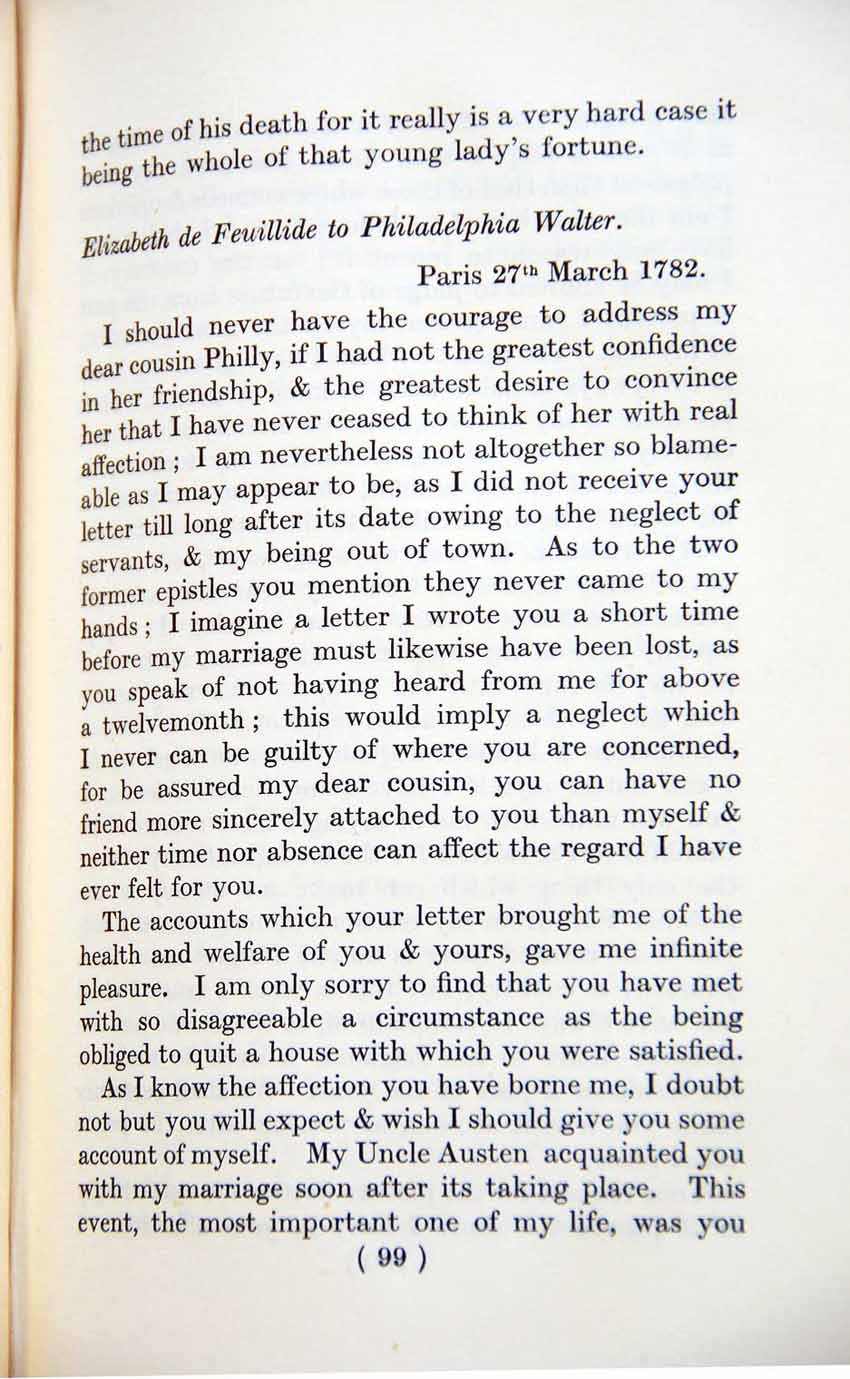
Extract from Life and Letters (1913), p. 38.
Your accommodations at Steventon are the only things my Aunt Austen and myself are uneasy about, as the house being very full of company, she says she can only promise you 'a place to hide your head in,' but I think you will not mind this inconvenience. I am sure I should not—to be with you. Do not let your dress neither disturb you, as I think I can manage it so that the Green Room should provide you with what is necessary for acting. We purpose setting out the 17th of December. . . . I assure you we shall have a most brilliant party and a great deal of amusement, the house full of company, frequent balls. You cannot possibly resist so many temptations, especially when I tell you your old friend James is returned from France and is to be of the acting party.
The invitation is dated 16 November 1787 in Austen Papers, pp. 126–128. Eliza is trying to recruit Philadelphia for the Steventon plays; James is Jane Austen’s eldest brother. The fuller printed letter includes omissions, a signature and an address. It is distinct from Eliza’s further appeal of 23 November.
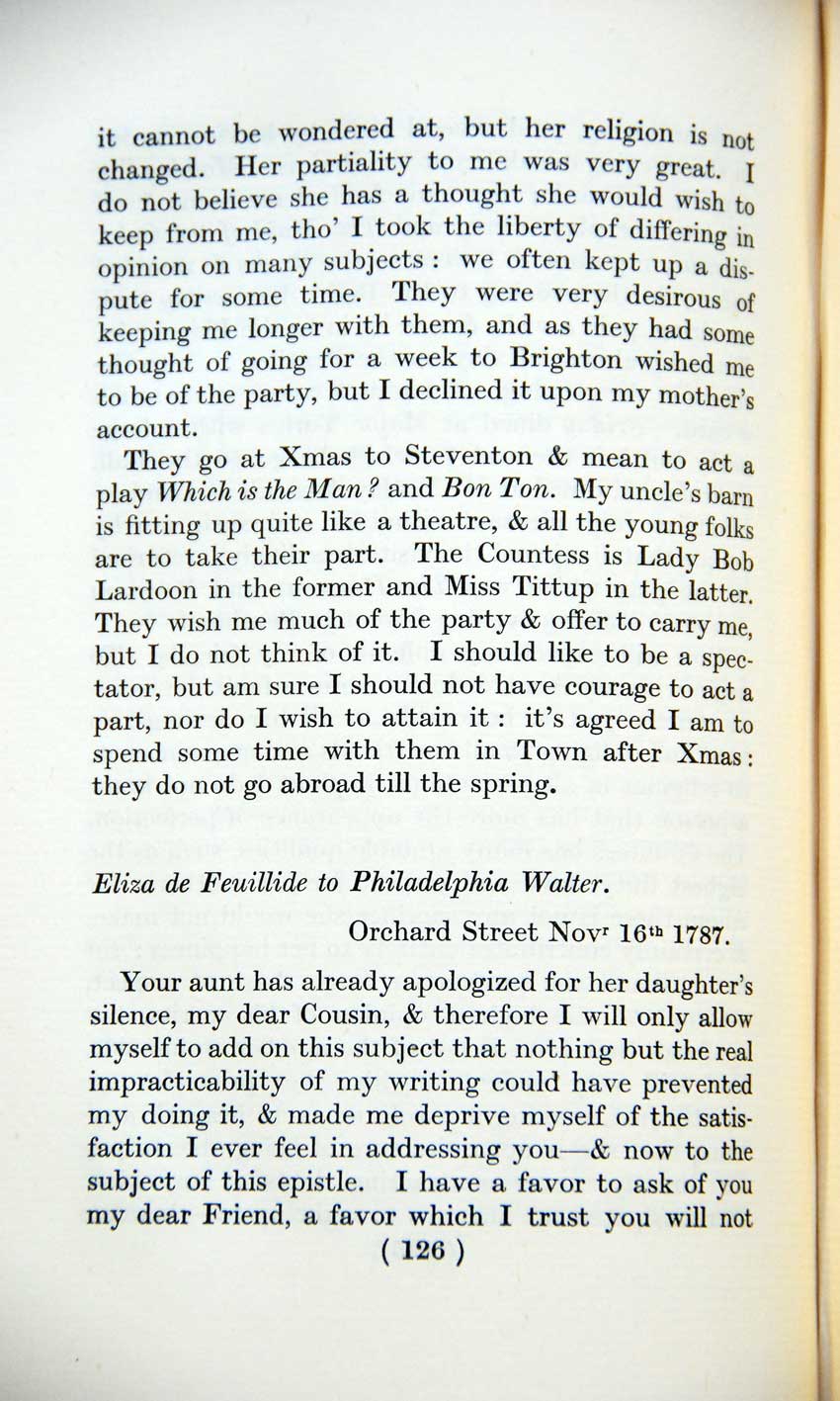
Extract from Life and Letters (1913), p. 65.
for my Aunt Austen declares "she has not room for any idle young people."
A fragment of Eliza’s renewed invitation to Philadelphia, dated 23 November 1787 in Austen Papers, p. 128. Her aunt is Jane’s mother: she is quoted inside Eliza’s letter, not writing a separate message. The fuller passage reassures Philadelphia that only invited friends will see the play; she would not be performing in a public theatre.
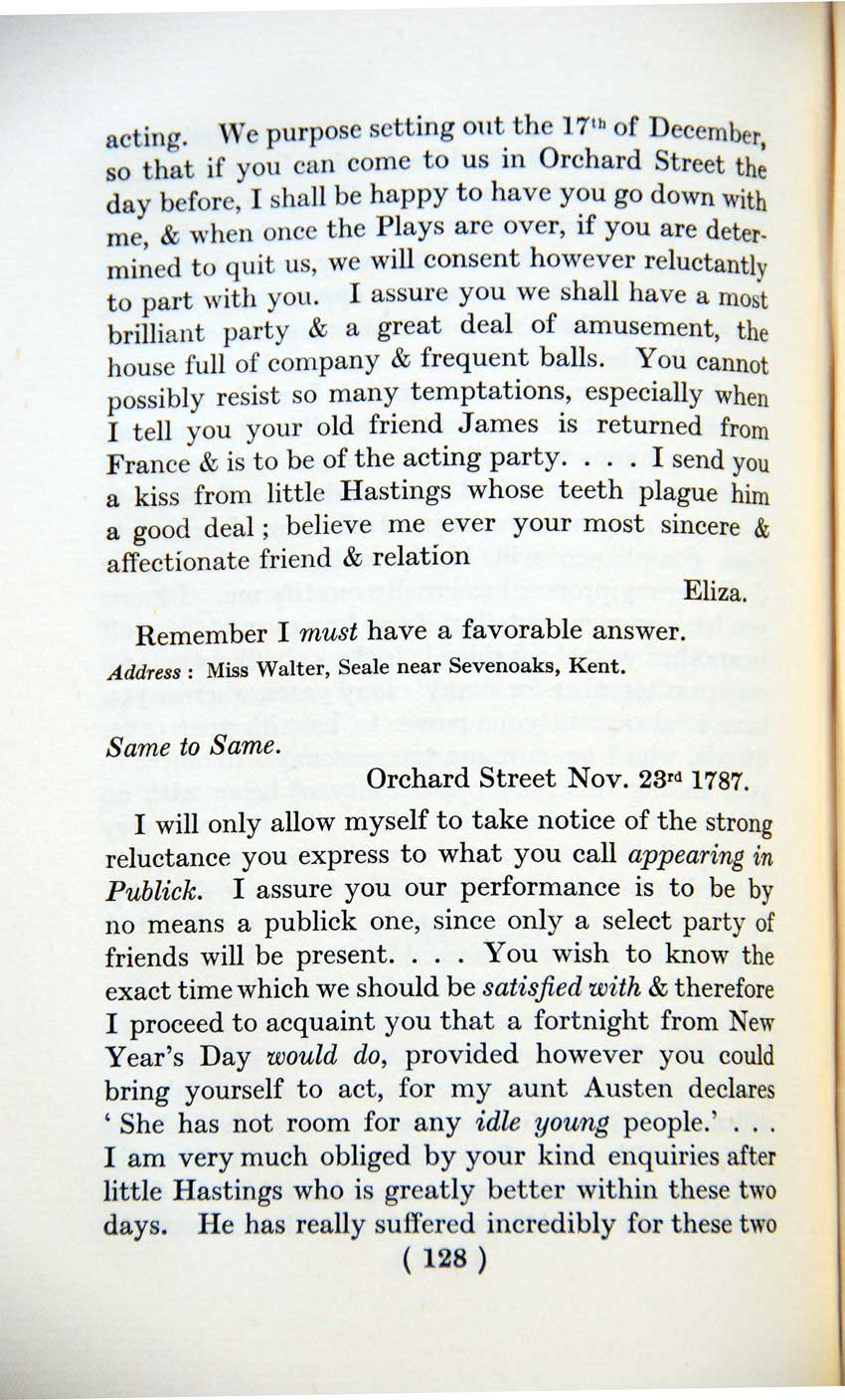
Extract from Life and Letters (1913), p. 65.
a journey from which I promise myself much pleasure, as I have a notion it is a place quite after my own heart; however, the accomplishment of this plan is very uncertain, as from the present appearance of things, France will probably be engaged in a war which will not admit of an officer's (whose services will certainly be required) quitting his country at such a period. . . . My mother has this very morning received a letter from Steventon, where they all enjoy perfect health. The youngest boy, Charles, is gone to the Naval Academy at Portsmouth. As to the young ladies, I hear they are perfect Beauties, and of course gain hearts by dozens.
The proposed journey is to Bath with Eliza’s mother and husband, not to India or France. Life and Letters, pp. 42–43 places it in September 1791; the same book calls the “perfect Beauties” report August 1791 on p. 60. Charles is Jane’s youngest brother, and the young ladies are Jane and Cassandra.
Extract from Life and Letters (1913), p. 43.
Edward A. I believe will . . . in another month or two take unto himself a spouse. He shewed me the lady's picture, which is that of a very pretty woman; as to Cassandra, it is very probable, as you observe, that some son of Neptune may have obtained her approbation as she probably experienced much homage from these gallant gentlemen during her acquatic excursions. I hear her sister and herself are two of the prettiest girls in England.
Life and Letters, pp. 42–43 places this extract in November 1791. Edward Austen is Jane’s brother; his future wife is Elizabeth Bridges. A “son of Neptune” means a sailor: Eliza is speculating about Cassandra’s admirers, not announcing an engagement. No exact day is supplied by this printing.
Extract from Life and Letters (1913), p. 43.
They talked much of the satisfaction their visit into Kent had afforded them. What did you think of my uncle's looks? I was much pleased with them, and if possible he appeared more amiable than ever to me. What an excellent and pleasing man he is; I love him most sincerely, as indeed I do all the family. I believe it was your first acquaintance with Cassandra and Jane.
“They” means George and Cassandra Austen and their daughters. The biographers introduce this extract with the family’s return from its summer 1788 visit to Kent (Life and Letters, p. 58). It belongs to that visit, although this printing gives no exact date. Eliza’s uncle here is Jane’s father, George Austen.
Extract from Life and Letters (1913), p. 58.
James has chosen a second wife in the person of Miss Mary Lloyd, who is not either rich or handsome, but very sensible and good humoured. . . . Jane seems much pleased with the match, and it is natural she should, having long known and liked the lady.
James is Jane’s eldest brother, widowed in 1795. Mary Lloyd will become his second wife in January 1797. Life and Letters, pp. 104–105 quotes Eliza’s reaction while discussing that marriage, but does not give this letter’s dateline. The ellipsis is part of the published extract.
Extract from Life and Letters (1913), p. 104.
I mean,
to spend a very few days in London, and, if my health allows me, immediately to pay a visit to Steventon, because my uncle informs us that Midsummer and Christmas are the only seasons when his mansion is sufficiently at liberty to admit of his receiving his friends.
These two pieces are separated by the biographers’ “she writes”, not by a new letter. Life and Letters, pp. 39–40 places the plan in the account of Eliza’s 1786 journey to England; the quotation itself is undated. George Austen’s boarding pupils explain why he can receive more visitors during the midsummer and Christmas holidays.
Extract from Life and Letters (1913), p. 39.