Jane Austen Letters

Turn your inbox into a peaceful, calm and organized experience with Tecotype.

Reading Anna’s novel

Jane reads her niece Anna’s novel in progress and suggests changes to its characters and plot. Anna is the daughter of Jane’s brother James; her unfinished novel is called Which is the Heroine?. Mrs. Forester, Susan and Sir Thomas are fictional characters in that story, not family correspondents. Jane reads it with Cassandra and their mother while Anna prepares to marry Ben Lefroy.

Jane Austen to Anna Austen
AUG 10, 1814

My dear Anna,—I am quite ashamed to find that I have never answered some question of yours in a former note. I kept it on purpose to refer to it at a proper time, and then forgot it. I like the name "Which is the Heroine" very well, and I dare say shall grow to like it very much in time; but "Enthusiasm" was something so very superior that my common title must appear to disadvantage. I am not sensible of any blunders about Dawlish; the library was pitiful and wretched twelve years ago, and not likely to have anybody's publications. There is no such title as Desborough, either among dukes, marquises, earls, viscounts, or barons. These were your inquiries. I will now thank you for your envelope received this morning. Your Aunt Cass is as well pleased with St. Julian as ever, and I am delighted with the idea of seeing Progillian again.

Wednesday, 17.—We have now just finished the first of the three books I had the pleasure of receiving yesterday. I read it aloud, and we are all very much amused, and like the work quite as well as ever. I depend on getting through another book before dinner, but there is really a good deal of respectable reading in your forty-eight pages. I have no doubt six would make a very good-sized volume. You must have been quite pleased to have accomplished so much. I like Lord Portman and his brother very much. I am only afraid that Lord P.'s good nature will make most people like him better than he deserves. The whole family are very good; and Lady Anne, who was your great dread, you have succeeded particularly well with. Bell Griffin is just what she should be. My corrections have not been more important than before; here and there we have thought the sense could be expressed in fewer words, and I have scratched out Sir Thos. from walking with the others to the stables, etc. the very day after breaking his arm; for though I find your papa did walk out immediately after his arm was set, I think it can be so little usual as to appear unnatural in a book. Lynn will not do. Lynn is towards forty miles from Dawlish and would not be talked of there. I have put Starcross instead. If you prefer Easton, that must be always safe.

I have also scratched out the introduction between Lord Portman and his brother and Mr. Griffin. A country surgeon (don't tell Mr. C. Lyford) would not be introduced to men of their rank; and when Mr. P. is first brought in, he would not be introduced as the Honorable. That distinction is never mentioned at such times; at least, I believe not. Now we have finished the second book, or rather the fifth. I do think you had better omit Lady Helena's postscript. To those that are acquainted with "Pride and Prejudice" it will seem an imitation. And your Aunt C. and I both recommend your making a little alteration in the last scene between Devereux F. and Lady Clanmurray and her daughter. We think they press him too much, more than sensible or well-bred women would do; Lady C., at least, should have discretion enough to be sooner satisfied with his determination of not going with them. I am very much pleased with Egerton as yet. I did not expect to like him, but I do, and Susan is a very nice little animated creature; but St. Julian is the delight of our lives. He is quite interesting. The whole of his break-off with Lady Helena is very well done. Yes; Russell Square is a very proper distance from Berkeley Square. We are reading the last book. They must be two days going from Dawlish to Bath. They are nearly one hundred miles apart.

Thursday.—We finished it last night after our return from drinking tea at the Great House. The last chapter does not please us quite so well; we do not thoroughly like the play, perhaps from having had too much of plays in that way lately (vide "Mansfield Park"), and we think you had better not leave England. Let the Portmans go to Ireland; but as you know nothing of the manners there, you had better not go with them. You will be in danger of giving false representations. Stick to Bath and the Foresters. There you will be quite at home.

Your Aunt C. does not like desultory novels, and is rather afraid yours will be too much so, that there will be too frequently a change from one set of people to another, and that circumstances will be introduced of apparent consequence which will lead to nothing. It will not be so great an objection to me if it does. I allow much more latitude than she does, and think Nature and spirit cover many sins of a wandering story, and people in general do not care so much about it for your comfort.

I should like to have had more of Devereux. I do not feel enough acquainted with him. You were afraid of meddling with him, I dare say. I like your sketch of Lord Clanmurray, and your picture of the two young girls' enjoyment is very good. I have not noticed St. Julian's serious conversation with Cecilia, but I like it exceedingly. What he says about the madness of otherwise sensible women on the subject of their daughters coming out is worth its weight in gold.

I do not perceive that the language sinks. Pray go on.
Jane’s advice about Ireland concerns Anna’s knowledge of the setting. The play and postscript comparisons refer to Mansfield Park and Pride and Prejudice.

Woolsey prints ‘Lynn’ and ‘Easton’; the Oxford manuscript edition and Life and Letters read ‘Lyme’ and ‘Exeter’. Oxford treats the writing sessions on 10, 17 and 18 August as one letter. The manuscript’s signature and postscript correcting Dorsetshire to Devonshire are absent from this selection.

Source: Woolsey selection, 1908 printing, letter 59.

Jane Austen to Anna Austen
SEP 9, 1814

Chawton, Sept. 9.

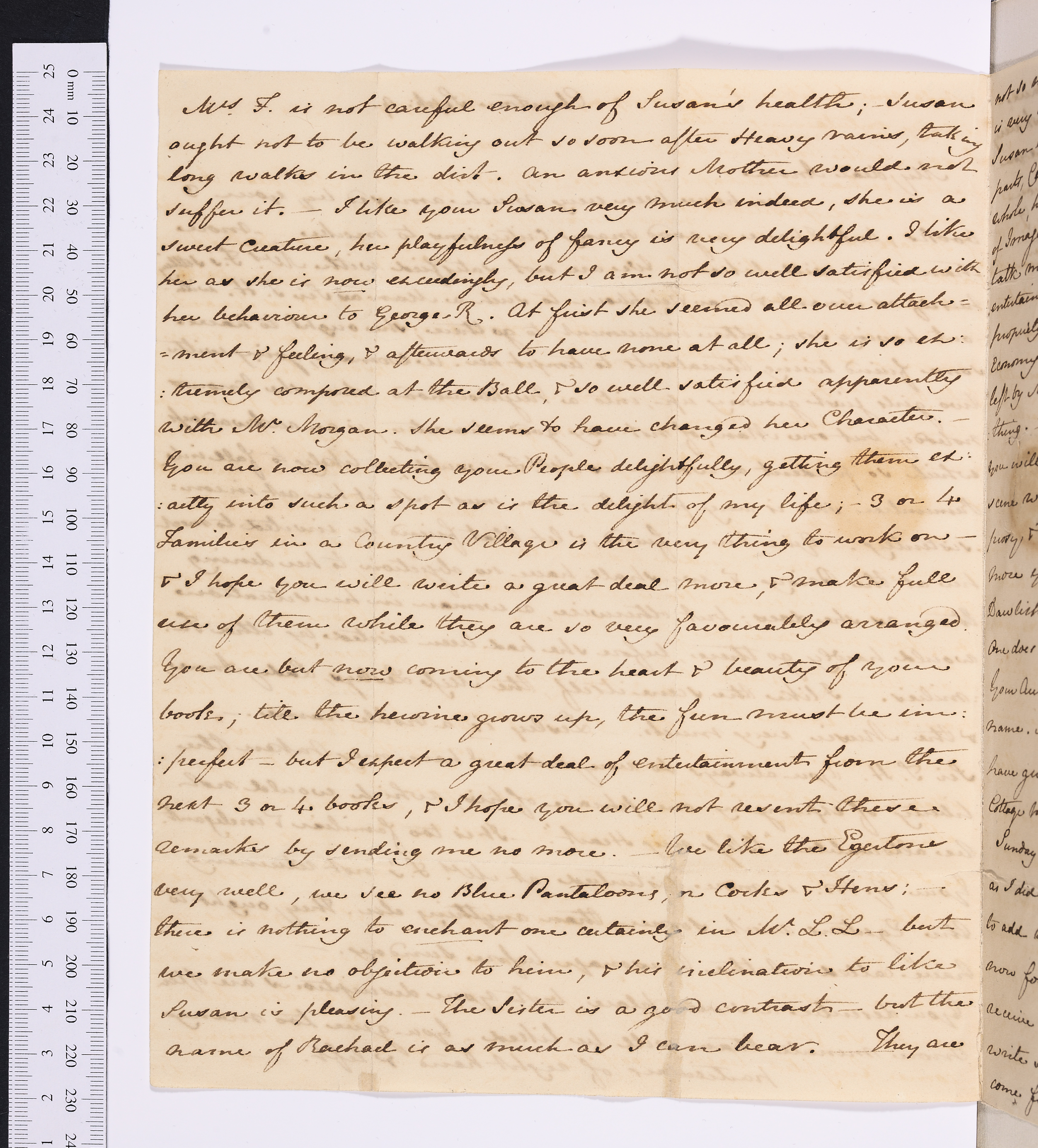
My dear Anna,—We have been very much amused by your three books, but I have a good many criticisms to make, more than you will like. We are not satisfied with Mrs. Forester settling herself as tenant and near neighbor to such a man as Sir Thomas, without having some other inducement to go there. She ought to have some friend living thereabouts to tempt her. A woman going with two girls just growing up into a neighborhood where she knows nobody but one man of not very good character, is an awkwardness which so prudent a woman as Mrs. F. would not be likely to fall into. Remember she is very prudent. You must not let her act inconsistently. Give her a friend, and let that friend be invited by Sir Thomas H. to meet her, and we shall have no objection to her dining at the Priory as she does; but otherwise a woman in her situation would hardly go there before she had been visited by other families. I like the scene itself, the Miss Leslie, Lady Anne, and the music very much. Leslie is a noble name. Sir Thomas H. you always do very well. I have only taken the liberty of expunging one phrase of his which would not be allowable,—"Bless my heart!" It is too familiar and inelegant. Your grandmother is more disturbed at Mrs. Forester's not returning the Egertons' visit sooner than by anything else. They ought to have called at the Parsonage before Sunday. You describe a sweet place, but your descriptions are often more minute than will be liked. You give too many particulars of right hand and left. Mrs. Forester is not careful enough of Susan's health. Susan ought not to be walking out so soon after heavy rains, taking long walks in the dirt. An anxious mother would not suffer it. I like your Susan very much; she is a sweet creature, her playfulness of fancy is very delightful. I like her as she is now exceedingly, but I am not quite so well satisfied with her behavior to George R. At first she seems all over attachment and feeling, and afterwards to have none at all; she is so extremely confused at the ball, and so well satisfied apparently with Mr. Morgan. She seems to have changed her character.

You are now collecting your people delightfully, getting them exactly into such a spot as is the delight of my life. Three or four families in a country village is the very thing to work on, and I hope you will do a great deal more, and make full use of them while they are so very favorably arranged.

You are but now coming to the heart and beauty of your story. Until the heroine grows up the fun must be imperfect, but I expect a great deal of entertainment from the next three or four books, and I hope you will not resent these remarks by sending me no more. We like the Egertons very well. We see no blue pantaloons or cocks or hens. There is nothing to enchant one certainly in Mr. L. L., but we make no objection to him, and his inclination to like Susan is pleasing. The sister is a good contrast, but the name of Rachel is as much as I can bear. They are not so much like the Papillons as I expected. Your last chapter is very entertaining, the conversation on genius, etc.; Mr. St. Julian and Susan both talk in character, and very well. In some former parts Cecilia is perhaps a little too solemn and good, but upon the whole her disposition is very well opposed to Susan's, her want of imagination is very natural. I wish you could make Mrs. Forester talk more; but she must be difficult to manage and make entertaining, because there is so much good sense and propriety about her that nothing can be made very broad. Her economy and her ambition must not be staring. The papers left by Mrs. Fisher are very good. Of course one guesses something. I hope when you have written a great deal more, you will be equal to scratching out some of the past. The scene with Mrs. Mellish I should condemn; it is prosy and nothing to the purpose, and indeed the more you can find in your heart to curtail between Dawlish and Newton Priors, the better I think it will be,—one does not care for girls until they are grown up. Your Aunt C. quite understands the exquisiteness of that name,—Newton Priors is really a nonpareil. Milton would have given his eyes to have thought of it. Is not the cottage taken from Tollard Royal?

[Thus far the letter was written on the 9th, but before it was finished news arrived at Chawton of the death of Mrs. Charles Austen. She died in her confinement, and the baby died also. She left three little girls,—Cassie, Harriet, and Fanny. It was not until the 18th that Jane resumed her letter as follows:]

Sunday.—I am very glad, dear Anna, that I wrote as I did before this sad event occurred. I have only to add that your grandmamma does not seem the worse now for the shock.

I shall be very happy to receive more of your work if more is ready; and you write so fast that I have great hopes Mr. Digweed will come back freighted with such a cargo as not all his hops or his sheep could equal the value of.

Your grandmamma desires me to say that she will have finished your shoes to-morrow, and thinks they will look very well. And that she depends upon seeing you, as you promise, before you quit the country, and hopes you will give her more than a day.

Yours affectionately. J. Austen.

Jane’s ‘three or four families’ describes the promising arrangement of Anna’s current story. She is encouraging that particular work. The letter continues on 18 September.

Woolsey prints ‘confused at the ball’; the manuscript and Life and Letters read ‘composed at the Ball’. This changes Jane’s criticism of Susan’s apparent attachment.

The bracketed account of Mrs. Charles Austen’s death is the printed editor’s explanation, not Jane’s words.

Source: Woolsey selection, 1908 printing, letter 60.

Jane Austen to Anna Austen
SEP 28, 1814

Chawton, Wednesday (Sept. 28).

My dear Anna,—I hope you do not depend on having your book again immediately. I kept it that your grandmamma may hear it, for it has not been possible yet to have any public reading. I have read it to your Aunt Cassandra, however, in our own room at night, while we undressed, and with a great deal of pleasure. We like the first chapter extremely, with only a little doubt whether Lady Helena is not almost too foolish. The matrimonial dialogue is very good certainly. I like Susan as well as ever, and begin now not to care at all about Cecilia; she may stay at Easton Court as long as she likes. Henry Mellish will be, I am afraid, too much in the common novel style,—a handsome, amiable, unexceptionable young man (such as do not much abound in real life), desperately in love and all in vain. But I have no business to judge him so early Jane Egerton is a very natural, comprehensible girl, and the whole of her acquaintance with Susan and Susan's letter to Cecilia are very pleasing and quite in character. But Miss Egerton does not entirely satisfy us. She is too formal and solemn, we think, in her advice to her brother not to fall in love; and it is hardly like a sensible woman,—it is putting it into his head. We should like a few hints from her better. We feel really obliged to you for introducing a Lady Kenrick; it will remove the greatest fault in the work, and I give you credit for considerable forbearance as an author in adopting so much of our opinion. I expect high fun about Mrs. Fisher and Sir Thomas. You have been perfectly right in telling Ben. Lefroy of your work, and I am very glad to hear how much he likes it. His encouragement and approbation must be "quite beyond everything." I do not at all wonder at his not expecting to like anybody so well as Cecilia at first, but I shall be surprised if he does not become a Susanite in time. Devereux Forester's being ruined by his vanity is extremely good, but I wish you would not let him plunge into a "vortex of dissipation." I do not object to the thing, but I cannot bear the expression; it is such thorough novel slang, and so old that I dare say Adam met with it in the first novel he opened. Indeed, I did very much like to know Ben's opinion. I hope he will continue to be pleased with it, and I think he must, but I cannot flatter him with there being much incident. We have no great right to wonder at his not valuing the name of Progillian. That is a source of delight which even he can hardly be quite competent to.

Walter Scott has no business to write novels, especially good ones. It is not fair. He has fame and profit enough as a poet, and should not be taking the bread out of the mouths of other people.

I do not like him, and do not mean to like "Waverley" if I can help it, but fear I must.

I am quite determined, however, not to be pleased with Mrs. West's "Alicia De Lacy," should I ever meet with it, which I hope I shall not. I think I can be stout against anything written by Mrs. West. I have made up my mind to like no novels really but Miss Edgeworth's, yours, and my own.

What can you do with Egerton to increase the interest for him? I wish you could contrive something, some family occurrence to bring out his good qualities more. Some distress among brothers and sisters to relieve by the sale of his curacy! Something to carry him mysteriously away, and then be heard of at York or Edinburgh in an old greatcoat. I would not seriously recommend anything improbable, but if you could invent something spirited for him, it would have a good effect. He might lend all his money to Captain Morris, but then he would be a great fool if he did. Cannot the Morrises quarrel and he reconcile them? Excuse the liberty I take in these suggestions.

Your Aunt Frank's nursemaid has just given her warning, but whether she is worth your having, or would take your place, I know not. She was Mrs. Webb's maid before she went to the Great House. She leaves your aunt because she cannot agree with the other servants. She is in love with the man, and her head seems rather turned. He returns her affection, but she fancies every one else is wanting him and envying her. Her previous service must have fitted her for such a place as yours, and she is very active and cleanly. The Webbs are really gone! When I saw the wagons at the door, and thought of all the trouble they must have in moving, I began to reproach myself for not having liked them better; but since the wagons have disappeared my conscience has been closed again, and I am excessively glad they are gone.

I am very fond of Sherlock's sermons, and prefer them to almost any.

Your affectionate aunt, J. Austen.

If you wish me to speak to the maid, let me know.

Waverley was published anonymously in 1814; Jane treats Walter Scott as its author here. Mrs. West is the novelist Jane West, and Miss Edgeworth is Maria Edgeworth. Jane objects to ‘vortex of dissipation’ as a worn-out expression, not to the event it describes.

The Oxford edition identifies Anna as the recipient. The overlapping extracts in Sailor Brothers and the Memoir give different or uncertain attributions. This selection omits some domestic details.

Source: Woolsey selection, 1908 printing, letter 61.

Jane Austen to Anna Austen
NOV 30, 1814

Hans Place, Wednesday.

My dear Anna,—I have been very far from finding your book an evil, I assure you. I read it immediately and with great pleasure. I think you are going on very well. The description of Dr. Griffin and Lady Helena's unhappiness is very good, and just what was likely to be. I am curious to know what the end of them will be. The name of Newton Priors is really invaluable; I never met with anything superior to it. It is delightful, and one could live on the name of Newton Priors for a twelvemonth. Indeed, I think you get on very fast. I only wish other people of my acquaintance could compose as rapidly. I am pleased with the dog scene and with the whole of George and Susan's love, but am more particularly struck with your serious conversations. They are very good throughout. St. Julian's history was quite a surprise to me. You had not very long known it yourself, I suspect; but I have no objection to make to the circumstance, and it is very well told. His having been in love with the aunt gives Cecilia an additional interest with him. I like the idea,—a very proper compliment to an aunt! I rather imagine indeed that nieces are seldom chosen but out of compliment to some aunt or another. I dare say Ben was in love with me once, and would never have thought of you if he had not supposed me dead of scarlet fever. Yes, I was in a mistake as to the number of books. I thought I had read three before the three at Chawton, but fewer than six will not do. I want to see dear Bell Griffin again; and had you not better give some hint of St. Julian's early history in the beginning of the story?

We shall see nothing of Streatham while we are in town, as Mrs. Hill is to lie in of a daughter. Mrs. Blackstone is to be with her. Mrs. Heathcote and Miss Bigg are just leaving. The latter writes me word that Miss Blackford is married, but I have never seen it in the papers, and one may as well be single if the wedding is not to be in print.

Your affectionate aunt, J. A.

Anna married Ben Lefroy on 8 November. The joke about Ben once loving her aunt responds to Anna’s novel, not an actual courtship.

The Oxford catalogue dates the matching first leaf to 30 November 1814. Its dateline is only ‘Wednesday’; the day and month are supplied. That leaf ends mid-sentence.

The final paragraph about Streatham and Miss Blackford may belong to February–March 1815 (discussion). This selection may combine letters; its heading does not securely date every paragraph.

Source: Woolsey selection, 1908 printing, letter 65.

Jane Austen to Anna Austen
1814

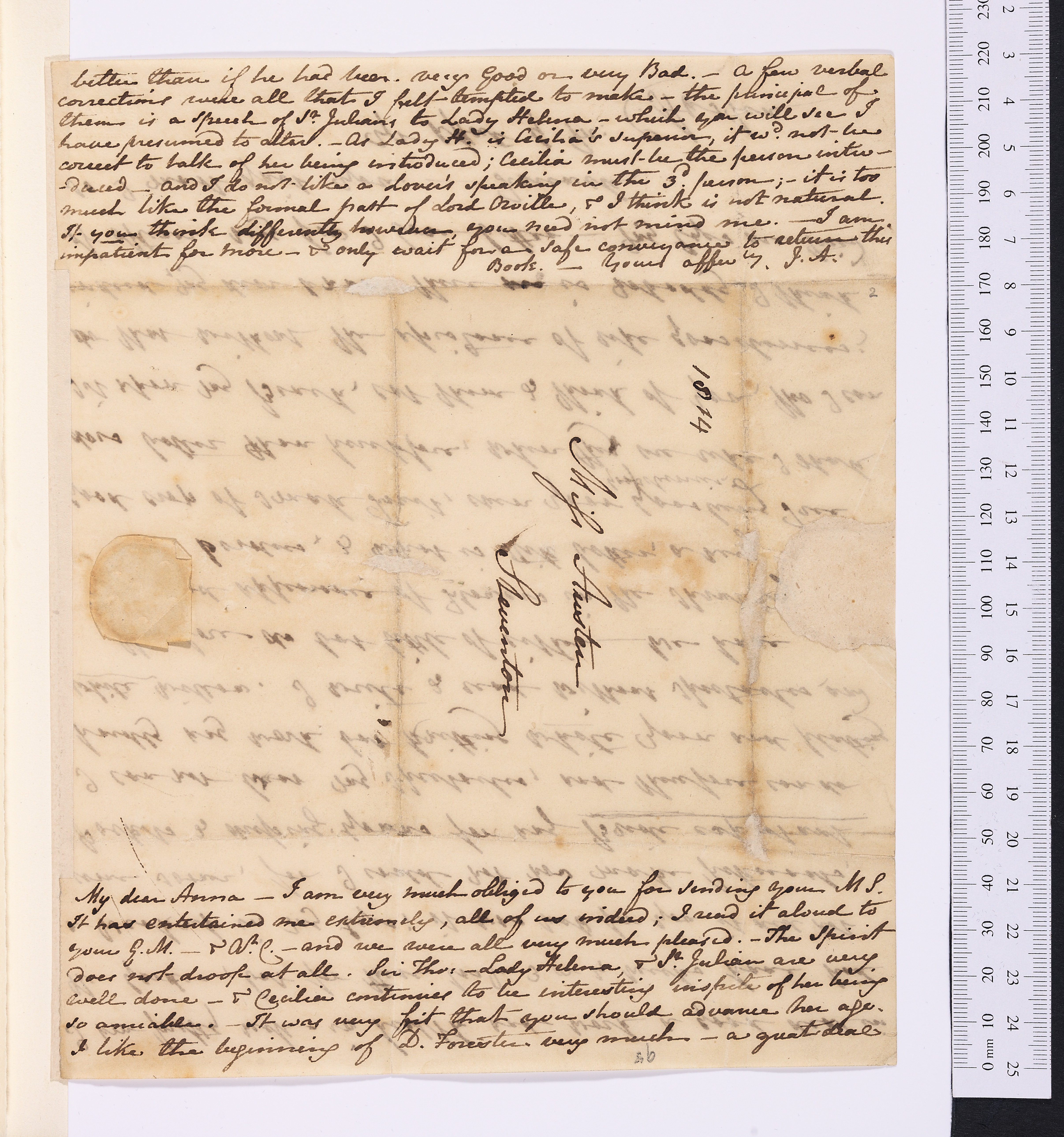
My dear Anna,—I am very much obliged to you for sending your MS. It has entertained me extremely; indeed all of us. I read it aloud to your grandmamma and Aunt Cass, and we were all very much pleased. The spirit does not droop at all. Sir Thos., Lady Helen, and St. Julian are very well done, and Cecilia continues to be interesting in spite of her being so amiable. It was very fit you should advance her age. I like the beginning of Devereux Forester very much, a great deal better than if he had been very good or very bad. A few verbal corrections are all that I felt tempted to make; the principal of them is a speech of St. Julian to Lady Helen, which you see I have presumed to alter. As Lady H. is Cecilia's superior, it would not be correct to talk of her being introduced. It is Cecilia who must be introduced. And I do not like a lover speaking in the 3rd person; it is too much like the part of Lord Overtley, and I think it not natural. If you think differently, however, you need not mind me. I am impatient for more, and only wait for a safe conveyance to return this.

Yours affectionately, J. A.

Lord Orville is a character in Frances Burney’s Evelina, not Anna’s novel. This is Jane’s contribution on the surviving last leaf of a letter from Anna’s grandmother, not a complete independent letter.

The letter is undated. Life and Letters suggests May or June 1814; the Oxford edition records an endorsement, ‘?1814’. The year remains uncertain.

Woolsey prints ‘part of Lord Overtley’; Oxford and Life and Letters read ‘formal part of Lord Orville’. Manuscript page.

Source: Woolsey selection, 1908 printing, letter 58.