Jane Austen Letters

Turn your inbox into a peaceful, calm and organized experience with Tecotype.

Pride and Prejudice and the Godmersham household · 1813

Jane tells Cassandra about the arrival and reception of Pride and Prejudice, then writes during visits to London and Godmersham. Their brother Edward and his children now use the surname Knight. His eldest daughter Fanny is Jane's companion; Lizzy and Marianne are Fanny's younger sisters. Mrs. Sackree is the family's nurse and Miss Clewes its governess. Some readings preserve only extracts, and two autumn letters include a niece's writing before Jane takes over. Household identities and the visit, Brabourne, introduction to the 1813 letters.

Jane Austen to Cassandra Elizabeth Austen
JAN 24, 1813

Chawton: Sunday evening [January 24, 1813].

My dear Cassandra,—This is exactly the weather we could wish for, if you are but well enough to enjoy it. I shall be glad to hear that you are not confined to the house by an increase of cold.

We quite run over with books. My mother has got Sir John Carr's Travels in Spain from Miss B. and I am reading a Society octavo, An Essay on the Military Police and Institutions of the British Empire by Capt. Pasley of the Engineers: a book which I protested against at first, but which upon trial I find delightfully written and highly entertaining. I am as much in love with the author as ever I was with Clarkson or Buchanan, or even the two Mr. Smiths of the City—the first soldier I ever sighed for—but he does write with extraordinary force and spirit. Yesterday, moreover, brought us Mrs. Grant's Letters with Mr. White's compliments; but I have disposed of them, compliments and all, for the first fortnight to Miss Papillon, and among so many readers or retainers of books as we have in Chawton I dare say there will be no difficulty in getting rid of them for another fortnight if necessary. I learn from Sir J. Carr that there is no Government House at Gibraltar; I must alter it to the Commissioner's.

Our party on Wednesday was not unagreeable. . . . We were eleven altogether, as you will find on computation, adding Miss Benn and two strange gentlemen, a Mr. Twyford, curate of Great Worldham, who is living in Alton, and his friend Mr. Wilkes. I don't know that Mr. T. is anything except very dark-complexioned, but Mr. W. was a useful addition, being an easy, talking, pleasantish young man—a very young man, hardly twenty, perhaps. He is of St. John's, Cambridge, and spoke very highly of H. Walter as a scholar. He said he was considered as the best classic in the University. How such a report would have interested my father!

Upon Mrs. D.'s mentioning that she had sent the Rejected Addresses to Mr. H., I began talking to her a little about them, and expressed my hope of their having amused her. Her answer was 'Oh dear, yes, very much, very droll indeed—the opening of the House and the striking up of the fiddles!' What she meant, poor woman, who shall say? I sought no farther. The P.'s have now got the book, and like it very much; their niece Eleanor has recommended it most warmly to them—She looks like a rejected addresser. As soon as a whist party was formed, and a round table threatened, I made my mother an excuse and came away, leaving just as many for their round table as there were at Mrs. Grant's. I wish they might be as agreeable a set.

The Miss Sibleys want to establish a Book Society in their side of the country like ours. What can be a stronger proof of that superiority in ours over the Manydown and Steventon society, which I have always foreseen and felt? No emulation of the kind was ever inspired by their proceedings; no such wish of the Miss Sibleys was ever heard in the course of the many years of that Society's existence. And what are their Biglands and their Barrows, their Macartneys and Mackenzies to Captain Pasley's Essay on the Military Police of the British Empire and the Rejected Addresses?

I have walked once to Alton, and yesterday Miss Papillon and I walked together to call on the Garnets. . . . I had a very agreeable walk, and if she had not, more shame for her, for I was quite as entertaining as she was. Dame G. is pretty well, and we found her surrounded by her well-behaved, healthy, large-eyed children. I took her an old shift, and promised her a set of our linen, and my companion left some of her Bank Stock with her.

Tell Martha that I hunt away the rogues every night from under her bed; they feel the difference of her being gone.

Jane Austen to Cassandra Austen
JAN 29, 1813

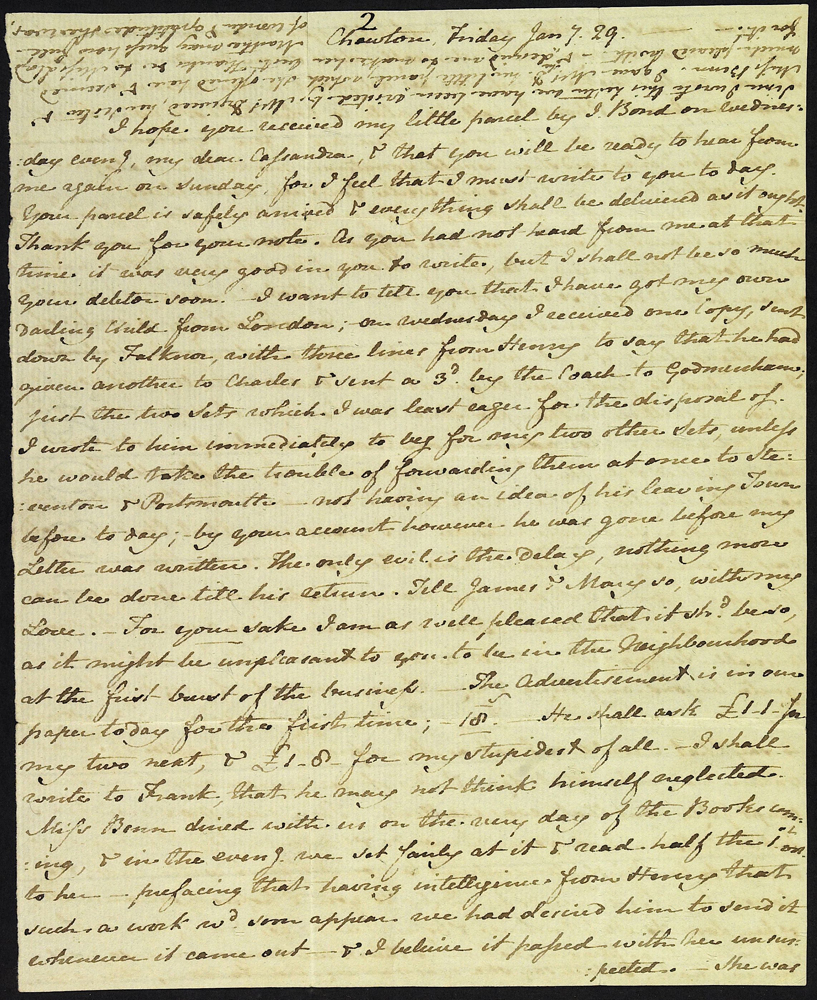
Chawton Friday Jany. 29.

I hope you received my little parcel by J. Bond on Wednesday evening, my dear Cassandra, & that you will be ready to hear from me again on Sunday, for I feel that I must write to you to day. Your parcel is safely arrived & everything shall be delivered as it ought. Thank you for your note. As you had not heard from me at that time it was very good in you to write, but I shall not be so much your debtor soon.—I want to tell you that I have got my own darling Child from London;—on Wednesday I received one Copy, sent down by Falknor, with three lines from Henry to say that he had given another to Charles & sent a 3d by the Coach to Godmersham; just the two Sets which I was least eager for the disposal of. I wrote to him immediately to beg for my two other Sets, unless he would take the trouble of forwarding them at once to Steventon & Portsmouth—not having an idea of his leaving Town before to day;—by your account however he was gone before my Letter was written. The only evil is the delay, nothing more can be done till his return. Tell James & Mary so, with my Love.—For your sake I am as well pleased that it should be so, as it might be unpleasant to you to be in the Neighbourhood at the first burst of the business.—The Advertisement is in our paper to day for the first time;—18s.—He shall ask £1-1- for my two next, & £1-8- for my stupidest of all.—I shall write to Frank, that he may not think himself neglected.

Miss Benn dined with us on the very day of the Books coming, & in the evening we set fairly at it & read half the 1st vol. to her—prefacing that having intelligence from Henry that such a work would soon appear we had desired him to send it whenever it came out—& I beleive it passed with her unsuspected.—She was amused, poor soul! that she could not help you know, with two such people to lead the way; but she really does seem to admire Elizabeth. I must confess that I think her as delightful a creature as ever appeared in print, & how I shall be able to tolerate those who do not like her at least, I do not know.—There are a few Typical errors—& a “said he” or a “said she” would sometimes make the Dialogue more immediately clear—but “I do not write for such dull Elves” “As have not a great deal of Ingenuity themselves.”—The 2d vol. is shorter than I could wish—but the difference is not so much in reality as in look, there being a larger proportion of Narrative in that part. I have lopt & cropt so successfully however that I imagine it must be rather shorter than S. & S. altogether.

Now I will try to write of something else;—it shall be a complete change of subject—Ordination. I am glad to find your enquiries have ended so well.—If you could discover whether Northamptonshire is a Country of Hedgerows, I should be glad again.—We admire your Charades excessively, but as yet have guessed only the 1st. The others seem very difficult. There is so much beauty in the Versification however, that the finding them out is but a secondary pleasure.—I grant you that this is a cold day, & am sorry to think how cold you will be through the process of your visit at Manydown. I hope you will wear your China Crape. Poor wretch! I can see you shivering away, with your miserable feeling feet.—What a vile Character Mr. Digweed turns out, quite beyond anything & everything;—instead of going to Steventon they are to have a Dinnerparty next tuesday!—I am sorry to say that I could not eat a Mincepie at Mr. Papillon’s; I was rather head-achey that day, & could not venture on anything sweet except Jelly; but that was excellent.—There were no stewed pears, but Miss Benn had some almonds & raisins.—By the bye, she desired to be kindly remembered to you when I wrote last, & I forgot it.—Betsy sends her Duty to you & hopes you are well, & her Love to Miss Caroline & hopes she has got rid of her Cough. It was such a pleasure to her to think her Oranges were so well timed, that I dare say she was rather glad to hear of the Cough.

Since I wrote this Letter we have been visited by Mrs. Digweed, her Sister & Miss Benn. I gave Mrs. D. her little parcel, which she opened here & seemed much pleased with—& she desired me to make her best Thanks &c. to Miss Lloyd for it.—Martha may guess how full of wonder & gratitude she was.

The surviving leaf has two written sides and an upside-down postscript. No signature or address is visible.

Extract from Jane Austen’s House, CHWJA:JAHLTR.5, first side.

Jane Austen to Cassandra Austen
FEB 4, 1813

Chawton Thursday Feb: 4.

My dear Cassandra

Your letter was truely welcome & I am much obliged to you all for your praise; it came at a right time, for I had had some fits of disgust;—our 2d evening’s reading to Miss Benn had not pleased me so well, but I beleive something must be attributed to my Mother’s too rapid way of getting on—& tho’ she perfectly understands the Characters herself, she cannot speak as they ought.—Upon the whole however I am quite vain enough & well satisfied enough.—The work is rather too light & bright & sparkling;—it wants shade;—it wants to be stretched out here & there with a long Chapter—of sense if it could be had, if not of solemn specious nonsense—about something unconnected with the story; an Essay on Writing, a critique on Walter Scott, or the history of Buonaparté—or anything that would form a contrast & bring the reader with increased delight to the playfulness & Epigrammatism of the general stile.—I doubt your quite agreeing with me here.—I know your starched Notions.—The caution observed at Steventon with regard to the possession of the Book is an agreable surprise to me, & I heartily wish it may be the means of saving you from every thing unpleasant;—but you must be prepared for the Neighbourhood being perhaps already informed of there being such a work in the World, & in the Chawton World!—Dummer will do that you know.—It was spoken of here one morning when Mrs. D. called with Miss Benn.—The greatest blunder in the Printing that I have met with is in Page 220—Vol. 3. where two speeches are made into one.—There might as well have been no suppers at Longbourn, but I suppose it was the remains of Mrs. Bennet’s old Meryton habits.

I am sorry for your disappointment about Manydown, & fear this week must be a heavy one. As far as one may venture to judge at a distance of 20 miles you must miss Martha. For her sake I was glad to hear of her going, as I suppose she must have been growing anxious, & wanting to be again in scenes of agitation & exertion.—She had a lovely day for her journey. I walked to Alton, & dirt excepted, found it delightful,—it seemed like an old Feby. come back again.—Before I set out we were visited by Mrs. Edwards, & while I was gone Miss Beckford & Maria, & Miss Woolls & Harriet B. called, all of whom my Mother was glad to see & I very glad to escape.—John M. is sailed, & now Miss B. thinks his Father will really try for a house, & has hopes herself of avoiding Southampton;—this is, as it was repeated to me;—and I can tell the Miss Williamses that Miss Beckford has no intention of inviting them to Chawton.—Well done You.—I thought of you at Manydown in the Drawing room & in your China Crape;—therefore, you were in the Breakfast parlour in your Brown Bombasin;—if I thought of you so, you would have been in the Kitchen in your Morning stuff.—I feel that I have never mentioned the Harwoods in my Letters to you, which is shocking enough—but we are sincerely glad to hear all the good of them you send us. There is no chance I suppose, no danger of poor Mrs. H.s being persuaded to come to Chawton at present.—I hope John H. will not have more debts brought in, than he likes.—I am pleased with M. T.’s being to dine at Steventon;—it may enable you to be yet more decided with Fanny & help to settle her faith.—Thomas was married on saturday, the wedding was kept at Neatham, & that is all I know about it.—Browning is quite a new Broom & at present has no fault. He had lost some of his knowledge of waiting, & is I think rather slow; but he is not noisy & not at all above being taught.—The Back gate is regularly locked.—I did not forget Henry’s fee to Thomas.—I had a letter from Henry yesterday, written on sunday from Oxford; mine had been forwarded to him; Edward’s information therefore was correct.—He says that Copies were sent to S. & P. at the same time with the others.—He has some thoughts of going to Adlestrop—

Only one two-sided leaf survives here. It ends at ‘Adlestrop—’; the museum records that the second leaf has been separated. The letter is incomplete.

Extract from Jane Austen’s House, CHWJA:JAHLTR.6, first side.

Jane Austen to Cassandra Elizabeth Austen
FEB 9, 1813

Tuesday [February 9, 1813].

This will be a quick return for yours, my dear Cassandra; I doubt its having much else to recommend it; but there is no saying; it may turn out to be a very long and delightful letter.

I am exceedingly pleased that you can say what you do, after having gone through the whole work, and Fanny's praise is very gratifying. My hopes were tolerably strong of her, but nothing like a certainty. Her liking Darcy and Elizabeth is enough. She might hate all the others if she would. I have her opinion under her own hand this morning, but your transcript of it, which I read first, was not, and is not, the less acceptable. To me it is of course all praise, but the more exact truth which she sends you is good enough. . . .

I have been applied to for information as to the oath taken in former times of Bell, Book, and Candle, but have none to give. Perhaps you may be able to learn something of its origin and meaning at Manydown. Ladies who read those enormous great stupid thick quarto volumes which one always sees in the breakfast parlour there must be acquainted with everything in the world. I detest a quarto. Capt. Pasley's book is too good for their Society. They will not understand a man who condenses his thoughts into an octavo.

Miss Benn dined here on Friday. I have not seen her since—there is still work for one evening more. I know nothing of the P.'s. The C.'s are at home, and are reduced to read. They have got Miss Edgeworth. I have disposed of Mrs. Grant for the second fortnight to Mrs. D. It can make no difference to her which of the twenty-six fortnights in the year the three volumes lay in her house.

Yours very affectionately, J. Austen.

Miss Austen, Manydown—by favour of Mr. Gray.

Woolsey and the Memoir combine passages from two letters. This is the February passage; the January passage appears separately. Compare the museum records for 24 January and 9 February 1813.

Extract from Life and Letters (1913), p. 262.

Jane Austen to Cassandra Austen
MAY 20, 1813

Sloane Street, Thursday, May 20.

My dear Cassandra,—Before I say anything else, I claim a paper full of halfpence on the drawing-room mantelpiece; I put them there myself, and forgot to bring them with me. I cannot say that I have yet been in any distress for money, but I choose to have my due, as well as the Devil. How lucky we were in our weather yesterday! This wet morning makes one more sensible of it. We had no rain of any consequence. The head of the curricle was put half up three or four times, but our share of the showers was very trifling, though they seemed to be heavy all round us, when we were on the Hog's-back, and I fancied it might then be raining so hard at Chawton as to make you feel for us much more than we deserved. Three hours and a quarter took us to Guildford, where we stayed barely two hours, and had only just time enough for all we had to do there; that is, eating a long and comfortable breakfast, watching the carriages, paying Mr. Harrington, and taking a little stroll afterwards. From some views which that stroll gave us, I think most highly of the situation of Guildford. We wanted all our brothers and sisters to be standing with us in the bowling-green, and looking towards Horsham. I was very lucky in my gloves,—got them at the first shop I went to, though I went into it rather because it was near than because it looked at all like a glove-shop, and gave only four shillings for them; after which everybody at Chawton will be hoping and predicting that they cannot be good for anything, and their worth certainly remains to be proved; but I think they look very well. We left Guildford at twenty minutes before twelve (I hope somebody cares for these minutiæ), and were at Esher in about two hours more. I was very much pleased with the country in general. Between Guildford and Ripley I thought it particularly pretty, also about Painshill; and from a Mr. Spicer's grounds at Esher, which we walked into before dinner, the views were beautiful. I cannot say what we did not see, but I should think there could not be a wood, or a meadow, or palace, or remarkable spot in England that was not spread out before us on one side or other. Claremont is going to be sold: a Mr. Ellis has it now. It is a house that seems never to have prospered. After dinner we walked forward to be overtaken at the coachman's time, and before he did overtake us we were very near Kingston. I fancy it was about half-past six when we reached this house,—a twelve hours' business, and the horses did not appear more than reasonably tired. I was very tired too, and glad to get to bed early, but am quite well to-day. I am very snug in the front drawing-room all to myself, and would not say "thank you" for any company but you. The quietness of it does me good. I have contrived to pay my two visits, though the weather made me a great while about it, and left me only a few minutes to sit with Charlotte Craven. She looks very well, and her hair is done up with an elegance to do credit to any education. Her manners are as unaffected and pleasing as ever. She had heard from her mother to-day. Mrs. Craven spends another fortnight at Chilton. I saw nobody but Charlotte, which pleased me best. I was shown upstairs into a drawing-room, where she came to me; and the appearance of the room, so totally unschoollike, amused me very much: it was full of modern elegances.

Yours very affectly, J. A.

Jane Austen to Cassandra Austen
MAY 24, 1813

Sloane Street, Monday (May 24).

My dearest Cassandra,—I am very much obliged to you for writing to me. You must have hated it after a worrying morning. Your letter came just in time to save my going to Remnant's, and fit me for Christian's, where I bought Fanny's dimity.

I went the day before (Friday) to Layton's as I proposed, and got my mother's gown,—seven yards at 6s. 6d. I then walked into No. 10, which is all dirt and confusion, but in a very promising way; and after being present at the opening of a new account, to my great amusement, Henry and I went to the exhibition in Spring Gardens. It is not thought a good collection, but I was very well pleased, particularly (pray tell Fanny) with a small portrait of Mrs. Bingley, excessively like her.

I went in hopes of seeing one of her sister, but there was no Mrs. Darcy. Perhaps, however, I may find her in the great exhibition, which we shall go to if we have time. I have no chance of her in the collection of Sir Joshua Reynolds's paintings, which is now showing in Pall Mall, and which we are also to visit.

Mrs. Bingley's is exactly herself,—size, shaped face, features, and sweetness; there never was a greater likeness. She is dressed in a white gown, with green ornaments, which convinces me of what I had always supposed, that green was a favorite color with her. I dare say Mrs. D. will be in yellow.

Friday was our worst day as to weather. We were out in a very long and very heavy storm of hail, and there had been others before, but I heard no thunder. Saturday was a good deal better; dry and cold.

I gave 2s. 6d. for the dimity. I do not boast of any bargains, but think both the sarsenet and dimity good of their sort.

I have bought your locket, but was obliged to give 18s. for it, which must be rather more than you intended. It is neat and plain, set in gold.

We were to have gone to the Somerset House Exhibition on Saturday, but when I reached Henrietta Street Mr. Hampson was wanted there, and Mr. Tilson and I were obliged to drive about town after him, and by the time we had done it was too late for anything but home. We never found him after all.

I have been interrupted by Mrs. Tilson. Poor woman! She is in danger of not being able to attend Lady Drummond Smith's party to-night. Miss Burdett was to have taken her, and now Miss Burdett has a cough and will not go. My cousin Caroline is her sole dependence.

The events of yesterday were, our going to Belgrave Chapel in the morning, our being prevented by the rain from going to evening service at St. James, Mr. Hampson's calling, Messrs. Barlow and Phillips dining here, and Mr. and Mrs. Tilson's coming in the evening à l'ordinaire. She drank tea with us both Thursday and Saturday; he dined out each day, and on Friday we were with them, and they wish us to go to them to-morrow evening, to meet Miss Burdett, but I do not know how it will end. Henry talks of a drive to Hampstead, which may interfere with it.

I should like to see Miss Burdett very well, but that I am rather frightened by hearing that she wishes to be introduced to me. If I am a wild beast, I cannot help it. It is not my own fault.

There is no change in our plan of leaving London, but we shall not be with you before Tuesday. Henry thinks Monday would appear too early a day. There is no danger of our being induced to stay longer.

I have not quite determined how I shall manage about my clothes; perhaps there may be only my trunk to send by the coach, or there may be a band-box with it. I have taken your gentle hint, and written to Mrs. Hill.

The Hoblyns want us to dine with them, but we have refused. When Henry returns he will be dining out a great deal, I dare say; as he will then be alone, it will be more desirable; he will be more welcome at every table, and every invitation more welcome to him. He will not want either of us again till he is settled in Henrietta Street. This is my present persuasion. And he will not be settled there—really settled—till late in the autumn; "he will not be come to bide" till after September.

There is a gentleman in treaty for this house. Gentleman himself is in the country, but gentleman's friend came to see it the other day, and seemed pleased on the whole. Gentleman would rather prefer an increased rent to parting with five hundred guineas at once, and if that is the only difficulty it will not be minded. Henry is indifferent as to the which.

Get us the best weather you can for Wednesday, Thursday, and Friday. We are to go to Windsor in our way to Henley, which will be a great delight. We shall be leaving Sloane Street about twelve, two or three hours after Charles's party have begun their journey. You will miss them, but the comfort of getting back into your own room will be great. And then the tea and sugar!

I fear Miss Clewes is not better, or you would have mentioned it. I shall not write again unless I have any unexpected communication or opportunity to tempt me. I enclose Mr. Herington's bill and receipt.

I am very much obliged to Fanny for her letter; it made me laugh heartily, but I cannot pretend to answer it. Even had I more time, I should not feel at all sure of the sort of letter that Miss D. would write. I hope Miss Benn is got well again, and will have a comfortable dinner with you to-day.

Monday Evening.—We have been both to the exhibition and Sir J. Reynolds's, and I am disappointed, for there was nothing like Mrs. D. at either. I can only imagine that Mr. D. prizes any picture of her too much to like it should be exposed to the public eye. I can imagine he would have that sort of feeling,—that mixture of love, pride, and delicacy.

Setting aside this disappointment, I had great amusement among the pictures; and the driving about, the carriage being open, was very pleasant. I liked my solitary elegance very much, and was ready to laugh all the time at my being where I was. I could not but feel that I had naturally small right to be parading about London in a barouche.

Henry desires Edward may know that he has just bought three dozen of claret for him (cheap), and ordered it to be sent down to Chawton.

I should not wonder if we got no farther than Reading on Thursday evening, and so reach Steventon only to a reasonable dinner-hour the next day; but whatever I may write or you may imagine, we know it will be something different. I shall be quiet to-morrow morning; all my business is done, and I shall only call again upon Mrs. Hoblyn, etc.

Love to your much ... party.

Yours affectionately, J. Austen.

Jane Austen to Cassandra Austen
SEP 15, 1813

Henrietta St., Wednesday (Sept. 15, ½ past 8).

Here I am, my dearest Cassandra, seated in the breakfast, dining, sitting room, beginning with all my might. Fanny will join me as soon as she is dressed, and begin her letter.

We had a very good journey, weather and roads excellent; the three first stages for 1s. 6d., and our only misadventure the being delayed about a quarter of an hour at Kingston for horses, and being obliged to put up with a pair belonging to a hackney coach and their coachman, which left no room on the barouche box for Lizzy, who was to have gone her last stage there as she did the first; consequently we were all four within, which was a little crowded.

We arrived at a quarter-past four, and were kindly welcomed by the coachman, and then by his master, and then by William, and then by Mrs. Pengird, who all met us before we reached the foot of the stairs. Mde. Bigion was below dressing us a most comfortable dinner of soup, fish, bouillée, partridges, and an apple tart, which we sat down to soon after five, after cleaning and dressing ourselves, and feeling that we were most commodiously disposed of. The little adjoining dressing-room to our apartment makes Fanny and myself very well off indeed, and as we have poor Eliza's bed our space is ample every way.

Sace arrived safely about half-past six. At seven we set off in a coach for the Lyceum; were at home again in about four hours and a half; had soup and wine and water, and then went to our holes.

Edward finds his quarters very snug and quiet. I must get a softer pen. This is harder. I am in agonies. I have not yet seen Mr. Crabbe. Martha's letter is gone to the post.

I am going to write nothing but short sentences. There shall be two full stops in every line. Layton and Shear's is Bedford House. We mean to get there before breakfast if it's possible; for we feel more and more how much we have to do and how little time. This house looks very nice. It seems like Sloane Street moved here. I believe Henry is just rid of Sloane Street. Fanny does not come, but I have Edward seated by me beginning a letter, which looks natural.

Henry has been suffering from the pain in the face which he has been subject to before. He caught cold at Matlock, and since his return has been paying a little for past pleasure. It is nearly removed now, but he looks thin in the face, either from the pain or the fatigues of his tour, which must have been great.

Lady Robert is delighted with P. and P., and really was so, as I understand, before she knew who wrote it, for of course she knows now. He told her with as much satisfaction as if it were my wish. He did not tell me this, but he told Fanny. And Mr. Hastings! I am quite delighted with what such a man writes about it. Henry sent him the books after his return from Daylesford, but you will hear the letter too.

Let me be rational, and return to my two full stops.

I talked to Henry at the play last night. We were in a private box,—Mr. Spencer's,—which made it much more pleasant. The box is directly on the stage. One is infinitely less fatigued than in the common way. But Henry's plans are not what one could wish. He does not mean to be at Chawton till the 29th. He must be in town again by Oct. 5. His plan is to get a couple of days of pheasant shooting and then return directly. His wish was to bring you back with him. I have told him your scruples. He wishes you to suit yourself as to time, and if you cannot come till later, will send for you at any time as far as Bagshot. He presumed you would not find difficulty in getting so far. I could not say you would. He proposed your going with him into Oxfordshire. It was his own thought at first. I could not but catch at it for you.

We have talked of it again this morning (for now we have breakfasted), and I am convinced that if you can make it suit in other respects you need not scruple on his account. If you cannot come back with him on the 3rd or 4th, therefore, I do hope you will contrive to go to Adlestrop. By not beginning your absence till about the middle of this month I think you may manage it very well. But you will think all this over. One could wish he had intended to come to you earlier, but it cannot be helped.

I said nothing to him of Mrs. H. and Miss B., that he might not suppose difficulties. Shall not you put them into our own room? This seems to me the best plan, and the maid will be most conveniently near.

Oh, dear me! when I shall ever have done. We did go to Layton and Shear's before breakfast. Very pretty English poplins at 4s. 3d.; Irish, ditto at 6s.; more pretty, certainly,—beautiful.

Fanny and the two little girls are gone to take places for to-night at Covent Garden; "Clandestine Marriage" and "Midas." The latter will be a fine show for L. and M. They revelled last night in "Don Juan," whom we left in hell at half-past eleven. We had scaramouch and a ghost, and were delighted. I speak of them; my delight was very tranquil, and the rest of us were sober-minded. "Don Juan" was the last of three musical things. "Five Hours at Brighton," in three acts,—of which one was over before we arrived, none the worse,—and the "Beehive," rather less flat and trumpery.

I have this moment received 5l. from kind, beautiful Edward. Fanny has a similar gift. I shall save what I can of it for your better leisure in this place. My letter was from Miss Sharpe,—nothing particular. A letter from Fanny Cage this morning.

Four o'clock.—We are just come back from doing Mrs. Tickars, Miss Hare, and Mr. Spence. Mr. Hall is here, and while Fanny is under his hands, I will try to write a little more.

Miss Hare had some pretty caps, and is to make me one like one of them, only white satin instead of blue. It will be white satin and lace, and a little white flower perking out of the left ear, like Harriot Byron's feather. I have allowed her to go as far as 1l. 16s. My gown is to be trimmed everywhere with white ribbon plaited on somehow or other. She says it will look well. I am not sanguine. They trim with white very much.

I learnt from Mrs. Tickars's young lady, to my high amusement, that the stays now are not made to force the bosom up at all; that was a very unbecoming, unnatural fashion. I was really glad to hear that they are not to be so much off the shoulders as they were.

Going to Mr. Spence's was a sad business, and cost us many tears; unluckily we were obliged to go a second time before he could do more than just look. We went first at half-past twelve and afterwards at three; papa with us each time; and, alas! we are to go again to-morrow. Lizzy is not finished yet. There have been no teeth taken out, however, nor will be, I believe; but he finds hers in a very bad state, and seems to think particularly ill of their durableness. They have been all cleaned, hers filed, and are to be filed again. There is a very sad hole between two of her front teeth.

Thursday Morning, half-past Seven.—Up and dressed and downstairs in order to finish my letter in time for the parcel. At eight I have an appointment with Madame B., who wants to show me something downstairs. At nine we are to set off for Grafton House, and get that over before breakfast. Edward is so kind as to walk there with us. We are to be at Mr. Spence's again at 11.5: from that time shall be driving about I suppose till four o'clock at least. We are, if possible, to call on Mrs. Tilson.

Mr. Hall was very punctual yesterday, and curled me out at a great rate. I thought it looked hideous, and longed for a snug cap instead, but my companions silenced me by their admiration. I had only a bit of velvet round my head. I did not catch cold, however. The weather is all in my favor. I have had no pain in my face since I left you.

We had very good places in the box next the stage-box, front and second row; the three old ones behind, of course. I was particularly disappointed at seeing nothing of Mr. Crabbe. I felt sure of him when I saw that the boxes were fitted up with crimson velvet. The new Mr. Terry was Lord Ogleby, and Henry thinks he may do; but there was no acting more than moderate, and I was as much amused by the remembrances connected with "Midas" as with any part of it. The girls were very much delighted, but still prefer "Don Juan;" and I must say that I have seen nobody on the stage who has been a more interesting character than that compound of cruelty and lust.

It was not possible for me to get the worsteds yesterday. I heard Edward last night pressing Henry to come to you, and I think Henry engaged to go there after his November collection. Nothing has been done as to S. and S. The books came to hand too late for him to have time for it before he went. Mr. Hastings never hinted at Eliza in the smallest degree. Henry knew nothing of Mr. Trimmer's death. I tell you these things that you may not have to ask them over again.

There is a new clerk sent down to Alton, a Mr. Edmund Williams, a young man whom Henry thinks most highly of, and he turns out to be a son of the luckless Williamses of Grosvenor Place.

I long to have you hear Mr. H.'s opinion of P. and P. His admiring my Elizabeth so much is particularly welcome to me.

Instead of saving my superfluous wealth for you to spend, I am going to treat myself with spending it myself. I hope, at least, that I shall find some poplin at Layton and Shear's that will tempt me to buy it. If I do, it shall be sent to Chawton, as half will be for you; for I depend upon your being so kind as to accept it, being the main point. It will be a great pleasure to me. Don't say a word. I only wish you could choose too. I shall send twenty yards.

Now for Bath. Poor F. Cage has suffered a good deal from her accident. The noise of the White Hart was terrible to her. They will keep her quiet, I dare say. She is not so much delighted with the place as the rest of the party; probably, as she says herself, from having been less well, but she thinks she should like it better in the season. The streets are very empty now, and the shops not so gay as she expected. They are at No. 1 Henrietta Street, the corner of Laura Place, and have no acquaintance at present but the Bramstons.

Lady Bridges drinks at the Cross Bath, her son at the Hot, and Louisa is going to bathe. Dr. Parry seems to be half starving Mr. Bridges, for he is restricted to much such a diet as James's, bread, water and meat, and is never to eat so much of that as he wishes, and he is to walk a great deal,—walk till he drops, I believe,—gout or no gout. It really is to that purpose. I have not exaggerated.

Charming weather for you and us, and the travellers, and everybody. You will take your walk this afternoon, and . . .

Henrietta Street, the autumn of 1813. Miss Austen, Chawton. By favor of Mr. Gray.

Jane Austen to Cassandra Austen
SEP 16, 1813

Henrietta Street, Thursday (Sept. 16, after dinner),

Thank you, my dearest Cassandra, for the nice long letter I sent off this morning. I hope you have had it by this time, and that it has found you all well, and my mother no more in need of leeches. Whether this will be delivered to you by Henry on Saturday evening, or by the postman on Sunday morning, I know not, as he has lately recollected something of an engagement for Saturday, which perhaps may delay his visit. He seems determined to come to you soon, however.

I hope you will receive the gown to-morrow, and may be able with tolerable honesty to say that you like the color. It was bought at Grafton House, where, by going very early, we got immediate attendance and went on very comfortably. I only forgot the one particular thing which I had always resolved to buy there,—a white silk handkerchief,—and was therefore obliged to give six shillings for one at Crook and Besford's; which reminds me to say that the worsteds ought also to be at Chawton to-morrow, and that I shall be very happy to hear they are approved. I had not much time for deliberation.

We are now all four of us young ladies sitting round the circular table in the inner room writing our letters, while the two brothers are having a comfortable coze in the room adjoining. It is to be a quiet evening, much to the satisfaction of four of the six. My eyes are quite tired of dust and lamps.

The letter you forwarded from Edward, junr., has been duly received. He has been shooting most prosperously at home, and dining at Chilham Castle and with Mr. Scudamore.

My cap is come home, and I like it very much. Fanny has one also; hers is white sarsenet and lace, of a different shape from mine, more fit for morning carriage wear, which is what it is intended for, and is in shape exceedingly like our own satin and lace of last winter; shaped round the face exactly like it, with pipes and more fulness, and a round crown inserted behind. My cap has a peak in front. Large full bows of very narrow ribbon (old twopenny) are the thing. One over the right temple, perhaps, and another at the left ear.

Henry is not quite well. His stomach is rather deranged. You must keep him in rhubarb, and give him plenty of port and water. He caught his cold farther back than I told you,—before he got to Matlock, somewhere in his journey from the North; but the ill effects of that I hope are nearly gone.

We returned from Grafton House only just in time for breakfast, and had scarcely finished breakfast when the carriage came to the door. From eleven to half-past three we were hard at it; we did contrive to get to Hans Place for ten minutes. Mrs. T. was as affectionate and pleasing as ever.

After our return Mr. Tilson walked up from the Compting House and called upon us, and these have been all our visitings.

I have rejoiced more than once that I bought my writing-paper in the country; we have not had a quarter of an hour to spare.

I enclose the eighteen-pence due to my mother. The rose color was 6s. and the other 4s. per yard. There was but two yards and a quarter of the dark slate in the shop, but the man promised to match it and send it off correctly.

Fanny bought her Irish at Newton's in Leicester Square, and I took the opportunity of thinking about your Irish, and seeing one piece of the yard wide at 4s., and it seemed to me very good; good enough for your purpose. It might at least be worth your while to go there, if you have no other engagements. Fanny is very much pleased with the stockings she has bought of Remmington, silk at 12s., cotton at 4s. 3d. She thinks them great bargains, but I have not seen them yet, as my hair was dressing when the man and the stockings came.

The poor girls and their teeth! I have not mentioned them yet, but we were a whole hour at Spence's, and Lizzy's were filed and lamented over again, and poor Marianne had two taken out after all, the two just beyond the eye teeth, to make room for those in front. When her doom was fixed, Fanny, Lizzy, and I walked into the next room, where we heard each of the two sharp and hasty screams.

The little girls' teeth I can suppose in a critical state, but I think he must be a lover of teeth and money and mischief, to parade about Fanny's. I would not have had him look at mine for a shilling a tooth and double it. It was a disagreeable hour.

We then went to Wedgwood's, where my brother and Fanny chose a dinner-set. I believe the pattern is a small lozenge in purple, between lines of narrow gold, and it is to have the crest.

We must have been three-quarters of an hour at Grafton House, Edward sitting by all the time with wonderful patience. There Fanny bought the net for Anna's gown, and a beautiful square veil for herself. The edging there is very cheap. I was tempted by some, and I bought some very nice plaiting lace at 3s. 4d.

Fanny desires me to tell Martha, with her kind love, that Birchall assured her there was no second set of Hook's Lessons for Beginners, and that, by my advice, she has therefore chosen her a set by another composer. I thought she would rather have something than not. It costs six shillings.

With love to you all, including Triggs, I remain,

Yours very affectionately, J. Austen.

Henrietta St., autumn of 1813. Miss Austen, Chawton. By favor of

Jane Austen to Cassandra Austen
SEP 23, 1813

Godmersham Park: Thursday (Sept. 23).

MY DEAREST CASSANDRA,

Thank you five hundred and forty times for the exquisite piece of workmanship which was brought into the room this morning, while we were at breakfast, with some very inferior works of art in the same way, and which I read with high glee, much delighted with everything it told, whether good or bad. It is so rich in striking intelligence that I hardly know what to reply to first. I believe finery must have it.

I am extremely glad that you like the poplin. I thought it would have my mother's approbation, but was not so confident of yours. Remember that it is a present. Do not refuse me. I am very rich.

Mrs. Clement is very welcome to her little boy, and to my congratulations into the bargain, if ever you think of giving them. I hope she will do well. Her sister in Lucina, Mrs. H. Gipps, does too well, we think. Mary P. wrote on Sunday that she had been three days on the sofa. Sackree does not approve it.

Well, there is some comfort in the Mrs. Hulbart's not coming to you, and I am happy to hear of the honey. I was thinking of it the other day. Let me know when you begin the new tea, and the new white wine. My present elegancies have not yet made me indifferent to such matters. I am still a cat if I see a mouse.

I am glad you like our caps, but Fanny is out of conceit with hers already; she finds that she has been buying a new cap without having a new pattern, which is true enough. She is rather out of luck to like neither her gown nor her cap, but I do not much mind it, because besides that I like them both myself, I consider it as a thing of course at her time of life -- one of the sweet taxes of youth to choose in a hurry and make bad bargains.

I wrote to Charles yesterday, and Fanny has had a letter from him to-day, principally to make inquiries about the time of their visit here, to which mine was an answer beforehand; so he will probably write again soon to fix his week. I am best pleased that Cassy does not go to you.

Now, what have we been doing since I wrote last? The Mr. K.'s came a little before dinner on Monday, and Edward went to the church with the two seniors, but there is no inscription yet drawn up. They are very good-natured you know, and civil, and all that, but are not particularly superfine; however, they ate their dinner and drank their tea, and went away, leaving their lovely Wadham in our arms, and I wish you had seen Fanny and me running backwards and forwards with his breeches from the little chintz to the white room before we went to bed, in the greatest of frights lest he should come upon us before we had done it all. There had been a mistake in the housemaids' preparation, and they were gone to bed.

He seems a very harmless sort of young man, nothing to like or dislike in him -- goes out shooting or hunting with the two others all the morning, and plays at whist and makes queer faces in the evening.

On Tuesday the carriage was taken to the painter's; at one time Fanny and I were to have gone in it, chiefly to call on Mrs. C. -- Milles and Moy -- but we found that they were going for a few days to Sandling, and would not be at home; therefore my brother and Fanny went to Eastwell in the chair instead. While they were gone the Nackington Milles's called and left their cards. Nobody at home at Eastwell.

We hear a great deal of Geo. H.'s wretchedness. I suppose he has quick feelings, but I dare say they will not kill him. He is so much out of spirits, however, that his friend John Plumptre is gone over to comfort him, at Mr. Hatton's desire. He called here this morning in his way. A handsome young man certainly, with quiet, gentlemanlike manners. I set him down as sensible rather than brilliant. There is nobody brilliant nowadays. He talks of staying a week at Eastwell, and then comes to Chilham Castle for a day or two, and my brother invited him to come here afterwards, which he seemed very agreeable to.

"'Tis night, and the landscape is lovely no more," but to make amends for that, our visit to the Tyldens is over. My brother, Fanny, Edwd., and I went; Geo. stayed at home with W. K. There was nothing entertaining, or out of the common way. We met only Tyldens and double Tyldens. A whist-table for the gentlemen, a grown-up musical young lady to play backgammon with Fanny, and engravings of the Colleges at Cambridge for me. In the morning we returned Mrs. Sherer's visit. I like Mr. S. very much.

Well, I have not half done yet, I am not come up with myself. My brother drove Fanny to Nackington and Canty. yesterday, and while they were gone the Faggs paid their duty. Mary Oxenden is staying at Canty. with the Blairs, and Fanny's object was to see her.

The Deedes want us to come to Sandling for a few days, or at least a day and night. At present Edwd. does not seem well affected -- he would rather not be asked to go anywhere -- but I rather expect he will be persuaded to go for the one day and night.

I read him the chief of your letter; he was interested and pleased, as he ought, and will be happy to hear from you himself. Your finding so much comfort from his cows gave him evident pleasure. I wonder Henry did not go down on Saturday; he does not in general fall within a doubtful intention.

My face is very much as it was before I came away; for the first two or three days it was rather worse. I caught a small cold in my way down, and had some pain every evening, not to last long, but rather severer than it had been lately. This has worn off, however, and I have scarcely felt anything for the last two days.

Sackree is pretty well again, only weak. Much obliged to you for your message, &c.; it was very true that she blessed herself the whole time that the pain was not in her stomach. I read all the scraps I could of your letter to her. She seemed to like it, and says she shall always like to hear anything of Chawton now, and I am to make you Miss Clewes's assurance to the same effect, with thanks and best respects, &c.

The girls are much disturbed at Mary Stacey's not admitting Dame L. Miss C. and I are sorry, but not angry; we acknowledge Mary Stacey's right, and can suppose her to have reason.

Oh! the church must have looked very forlorn. We all thought of the empty pew. How Bentigh is grown! and the Canty. Hill Plantation! And the improvements within are very great. I admire the chintz room very much. We live in the library except at meals, and have a fire every evening. The weather is set about changing; we shall have a settled wet season soon. I must go to bed.

Friday. -- I am sorry to find that one of the nightcaps here belongs to you -- sorry, because it must be in constant wear.

Great doings again to-day. Fanny, Lizzy, and Marnne. are going to Goodnestone for the fair, which is to-morrow, and stay till Monday, and the gentlemen are all to dine at Evington. Edwd. has been repenting ever since he promised to go, and was hoping last night for a wet day, but the morning is fair. I shall dine with Miss Clewes, and I dare say find her very agreeable. The invitation to the fair was general. Edwd. positively declined his share of that, and I was very glad to do the same. It is likely to be a baddish fair -- not much upon the stall, and neither Mary O. nor Mary P.

It is hoped that the portfolio may be in Canty. this morning. Sackree's sister found it at Croydon and took it to town with her, but unluckily did not send it down till she had directions. Fanny C.'s screens can be done nothing with, but there are parts of workbags in the parcel, very important in their way. Three of the Deedes girls are to be at Goodnestone.

We shall not be much settled till this visit is over, settled as to employment I mean. Fanny and I are to go on with Modern Europe together, but hitherto have advanced only twenty-five pages. Something or other has always happened to delay or curtail the reading hour.

I ought to have told you before of a purchase of Edward's in town; he desired you might hear of it -- a thing for measuring timber with, so that you need not have the trouble of finding him in tapes any longer. He treated himself with this seven-shilling purchase, and bought a new watch and new gun for George. The new gun shoots very well.

Apples are scarce in this country -- 1l. 5s. a sack. Miss Hinton should take Hannah Knight. Mrs. Driver has not yet appeared. J. Littleworth and the grey pony reached Bath safely.

A letter from Mrs. Cooke: they have been at Brighton a fortnight; stay at least another, and Mary is already much better.

Poor Dr. Isham is obliged to admire P. and P., and to send me word that he is sure he shall not like Madame D'Arblay's new novel half so well. Mrs. C. invented it all, of course. He desires his compliments to you and my mother.

Of the Adlestrop living business, Mrs. C. says: "It can be now no secret, as the papers for the necessary dispensations are going up to the Archbishop's Secretary. However, be it known that we all wish to have it understood that George takes this trust entirely to oblige Mr. Leigh, and never will be a shilling benefited by it. Had my consent been necessary, believe me, I should have withheld it, for I do think it on the part of the patron a very shabby piece of business. All these and other Scrapings from dear Mrs. E. L. are to accumulate no doubt to help Mr. Twisleton to a secure admission again into England." I would wish you, therefore, to make it known to my mother as if this were the first time of Mrs. Cooke's mentioning it to me.

I told Mrs. C. of my mother's late oppressions in her head. She says on that subject: "Dear Mrs. Austen's is, I believe, an attack frequent at her age and mine. Last year I had for some time the sensation of a peck loaf resting on my head, and they talked of cupping me, but I came off with a dose or two of calomel, and have never heard of it since."

The three Miss Knights and Mrs. Sayce are just off; the weather has got worse since the early morning, and whether Mrs. Clewes and I are to be tête-à-tête, or to have four gentlemen to admire us, is uncertain.

I am now alone in the library, mistress of all I survey; at least I may say so, and repeat the whole poem if I like it, without offence to anybody.

Martha will have wet races and catch a bad cold; in other respects I hope she will have much pleasure at them, and that she is free from ear-ache now. I am glad she likes my cap so well. I assure you my old one looked so smart yesterday that I was asked two or three times before I set off whether it was not my new one.

I have this moment seen Mrs. Driver driven up to the kitchen door. I cannot close with a grander circumstance or greater wit.

Yours affectionately, J. A.

I am going to write to Steventon, so you need not send any news of me there.

Louisa's best love and a hundred thousand million kisses.

Miss Austen, Chawton, Alton, Hants.

Brabourne includes passages omitted by Woolsey. The year 1813 comes from the edition’s chronology and running heads, not the dateline.

Source: Brabourne (1884), volume II, p. 159.

A niece and Jane Austen to Cassandra Austen
OCT 11, 1813

Godmersham Park, Monday (Oct. 11).

[My dearest Aunt Cass.,—I have just asked Aunt Jane to let me write a little in her letter, but she does not like it, so I won't. Good-by!]

You will have Edward's letter to-morrow. He tells me that he did not send you any news to interfere with mine, but I do not think there is much for anybody to send at present.

We had our dinner-party on Wednesday, with the addition of Mrs. and Miss Milles, who were under a promise of dining here in their return from Eastwell, whenever they paid their visit of duty there, and it happened to be paid on that day. Both mother and daughter are much as I have always found them. I like the mother—first, because she reminds me of Mrs. Birch; and, secondly, because she is cheerful and grateful for what she is at the age of ninety and upwards. The day was pleasant enough. I sat by Mr. Chisholme, and we talked away at a great rate about nothing worth hearing.

It was a mistake as to the day of the Sherers going being fixed; they are ready, but are waiting for Mr. Paget's answer.

I inquired of Mrs. Milles after Jemima Brydges, and was quite grieved to hear that she was obliged to leave Canterbury some months ago on account of her debts, and is nobody knows where. What an unprosperous family!

On Saturday, soon after breakfast, Mr. J. P. left us for Norton Court. I like him very much. He gives me the idea of a very amiable young man, only too diffident to be so agreeable as he might be. He was out the chief of each morning with the other two, shooting and getting wet through. To-morrow we are to know whether he and a hundred young ladies will come here for the ball. I do not much expect any.

The Deedes cannot meet us; they have engagements at home. I will finish the Deedes by saying that they are not likely to come here till quite late in my stay,—the very last week perhaps; and I do not expect to see the Moores at all. They are not solicited till after Edward's return from Hampshire.

Monday, November 15, is the day now fixed for our setting out.

Poor Basingstoke races! There seem to have been two particularly wretched days on purpose for them; and Weyhill week does not begin much happier.

We were quite surprised by a letter from Anna at Tollard Royal, last Saturday; but perfectly approve her going, and only regret they should all go so far to stay so few days.

We had thunder and lightning here on Thursday morning, between five and seven; no very bad thunder, but a great deal of lightning. It has given the commencement of a season of wind and rain, and perhaps for the next six weeks we shall not have two dry days together.

Lizzy is very much obliged to you for your letter and will answer it soon, but has so many things to do that it may be four or five days before she can. This is quite her own message, spoken in rather a desponding tone. Your letter gave pleasure to all of us; we had all the reading of it of course,—I three times, as I undertook, to the great relief of Lizzy, to read it to Sackree, and afterwards to Louisa.

Sackree does not at all approve of Mary Doe and her nuts,—on the score of propriety rather than health. She saw some signs of going after her in George and Henry, and thinks if you could give the girl a check, by rather reproving her for taking anything seriously about nuts which they said to her, it might be of use. This, of course, is between our three discreet selves, a scene of triennial bliss.

Mrs. Breton called here on Saturday. I never saw her before. She is a large, ungenteel woman, with self-satisfied and would-be elegant manners.

We are certain of some visitors to-morrow. Edward Bridges comes for two nights in his way from Lenham to Ramsgate, and brings a friend—name unknown—but supposed to be a Mr. Harpur, a neighboring clergyman; and Mr. R. Mascall is to shoot with the young men, which it is to be supposed will end in his staying dinner.

On Thursday, Mr. Lushington, M.P. for Canterbury, and manager of the Lodge Hounds, dines here, and stays the night. He is chiefly young Edward's acquaintance. If I can I will get a frank from him, and write to you all the sooner. I suppose the Ashford ball will furnish something.

As I wrote of my nephews with a little bitterness in my last, I think it particularly incumbent on me to do them justice now, and I have great pleasure in saying that they were both at the Sacrament yesterday. After having much praised or much blamed anybody, one is generally sensible of something just the reverse soon afterwards. Now these two boys who are out with the foxhounds will come home and disgust me again by some habit of luxury or some proof of sporting mania, unless I keep it off by this prediction. They amuse themselves very comfortably in the evening by netting; they are each about a rabbit net, and sit as deedily to it, side by side, as any two Uncle Franks could do.

I am looking over "Self-Control" again, and my opinion is confirmed of its being an excellently meant, elegantly written work, without anything of nature or probability in it. I declare I do not know whether Laura's passage down the American river is not the most natural, possible, every-day thing she ever does.

Tuesday.—Dear me! what is to become of me? Such a long letter! Two-and-forty lines in the second page. Like Harriot Byron, I ask, what am I to do with my gratitude? I can do nothing but thank you and go on. A few of your inquiries, I think, are replied to en avance.

The name of F. Cage's drawing-master is O'Neil. We are exceedingly amused with your Shalden news, and your self-reproach on the subject of Mrs. Stockwell made me laugh heartily. I rather wondered that Johncock, the only person in the room, could help laughing too. I had not heard before of her having the measles. Mrs. H. and Alethea's staying till Friday was quite new to me; a good plan, however. I could not have settled it better myself, and am glad they found so much in the house to approve, and I hope they will ask Martha to visit them. I admire the sagacity and taste of Charlotte Williams. Those large dark eyes always judge well. I will compliment her by naming a heroine after her.

Edward has had all the particulars of the building, etc., read to him twice over, and seems very well satisfied. A narrow door to the pantry is the only subject of solicitude; it is certainly just the door which should not be narrow, on account of the trays; but if a case of necessity, it must be borne.

I knew there was sugar in the tin, but had no idea of there being enough to last through your company. All the better. You ought not to think this new loaf better than the other, because that was the first of five which all came together. Something of fancy, perhaps, and something of imagination.

Dear Mrs. Digweed! I cannot bear that she should not be foolishly happy after a ball. I hope Miss Yates and her companions were all well the day after their arrival. I am thoroughly rejoiced that Miss Benn has placed herself in lodgings, though I hope they may not be long necessary.

No letter from Charles yet.

Southey's "Life of Nelson." I am tired of "Lives of Nelson," being that I never read any. I will read this, however, if Frank is mentioned in it.

Here am I in Kent, with one brother in the same county and another brother's wife, and see nothing of them, which seems unnatural. It will not last so forever, I trust. I should like to have Mrs. F. A. and her children here for a week, but not a syllable of that nature is ever breathed. I wish her last visit had not been so long a one.

I wonder whether Mrs. Tilson has ever lain-in. Mention it if it ever comes to your knowledge, and we shall hear of it by the same post from Henry.

Mr. Rob. Mascall breakfasted here; he eats a great deal of butter. I dined upon goose yesterday, which, I hope, will secure a good sale of my second edition. Have you any tomatas? Fanny and I regale on them every day.

Disastrous letters from the Plumptres and Oxendens. Refusals everywhere—a blank partout—and it is not quite certain whether we go or not; something may depend upon the disposition of Uncle Edward when he comes, and upon what we hear at Chilham Castle this morning, for we are going to pay visits. We are going to each house at Chilham and to Mystole. I shall like seeing the Faggs. I shall like it all, except that we are to set out so early that I have not time to write as I would wish.

Edwd. Bridges's friend is a Mr. Hawker, I find, not Harpur. I would not have you sleep in such an error for the world.

My brother desires his best love and thanks for all your information. He hopes the roots of the old beech have been dug away enough to allow a proper covering of mould and turf. He is sorry for the necessity of building the new coin, but hopes they will contrive that the doorway should be of the usual width,—if it must be contracted on one side, by widening it on the other. The appearance need not signify. And he desires me to say that your being at Chawton when he is will be quite necessary. You cannot think it more indispensable than he does. He is very much obliged to you for your attention to everything. Have you any idea of returning with him to Henrietta Street and finishing your visit then? Tell me your sweet little innocent ideas.

Everything of love and kindness, proper and improper, must now suffice.

Yours very affectionately, J. Austen.

Miss Austen, Chawton, Alton, Hants.

Brabourne’s edition attributes the bracketed opening from “My dearest Aunt Cass.” through “Good-by!” to a niece. Jane continues at “You will have Edward’s letter to-morrow.” The niece’s identity and handwriting remain uncertain here. See the Morgan’s October 11–12, 1813 letter.

Source: Woolsey selection, 1908 printing, letter 48.

Jane Austen to Cassandra Austen
OCT 14, 1813

“October 14.—A letter from Wrotham yesterday offering an early visit here, and Mr. and Mrs. Moore and one child are to come on Monday for ten days. I hope Charles and Fanny may not fix the same time, but if they come at all in October they must. What is the use of hoping? The two parties of children is the chief evil.”

“To be sure, here we are; the very thing has happened, or rather worse—a letter from Charles this very morning, which gives us reason to suppose they may come here to-day. It depends upon the weather, and the weather now is very fine. No difficulties are made, however, and, indeed, there will be no want of room; but I wish there was no Wigrams and Lushingtons in the way to fill up the table, and make us such a motley set. I cannot spare Mr. Lushington either because of his frank, but Mr. Wigram does no good to anybody. I cannot imagine how a man can have the impudence to come into a family party for three days, where he is quite a stranger, unless he knows himself to be agreeable on undoubted authority. I shall be most happy to see dear Charles.”

Jane Austen to Cassandra Austen
OCT 14, 1813

Godmersham Park, Thursday (Oct. 14).

My dearest Cassandra,—Now I will prepare for Mr. Lushington, and as it will be wisest also to prepare for his not coming, or my not getting a frank, I shall write very close from the first, and even leave room for the seal in the proper place. When I have followed up my last with this I shall feel somewhat less unworthy of you than the state of our correspondence now requires.

I left off in a great hurry to prepare for our morning visits. Of course was ready a good deal the first, and need not have hurried so much. Fanny wore her new gown and cap. I was surprised to find Mystole so pretty.

The ladies were at home. I was in luck, and saw Lady Fagg and all her five daughters, with an old Mrs. Hamilton, from Canterbury, and Mrs. and Miss Chapman, from Margate, into the bargain. I never saw so plain a family,—five sisters so very plain! They are as plain as the Foresters, or the Franfraddops, or the Seagraves, or the Rivers, excluding Sophy. Miss Sally Fagg has a pretty figure, and that comprises all the good looks of the family.

It was stupidish; Fanny did her part very well, but there was a lack of talk altogether, and the three friends in the house only sat by and looked at us. However, Miss Chapman's name is Laura, and she had a double flounce to her gown. You really must get some flounces. Are not some of your large stock of white morning gowns just in a happy state for a flounce—too short? Nobody at home at either house in Chilham.

Edward Bridges and his friend did not forget to arrive. The friend is a Mr. Wigram, one of the three-and-twenty children of a great rich mercantile, Sir Robert Wigram, an old acquaintance of the Footes, but very recently known to Edward B. The history of his coming here is, that, intending to go from Ramsgate to Brighton, Edw. B. persuaded him to take Lenham on his way, which gave him the convenience of Mr. W.'s gig, and the comfort of not being alone there; but, probably thinking a few days of Gm. would be the cheapest and pleasantest way of entertaining his friend and himself, offered a visit here, and here they stay till to-morrow.

Mr. W. is about five or six-and-twenty, not ill-looking, and not agreeable. He is certainly no addition. A sort of cool, gentlemanlike manner, but very silent. They say his name is Henry, a proof how unequally the gifts of fortune are bestowed. I have seen many a John and Thomas much more agreeable.

We have got rid of Mr. R. Mascall, however. I did not like him, either. He talks too much, and is conceited, besides having a vulgarly shaped mouth. He slept here on Tuesday, so that yesterday Fanny and I sat down to breakfast with six gentlemen to admire us.

We did not go to the ball. It was left to her to decide, and at last she determined against it. She knew that it would be a sacrifice on the part of her father and brothers if they went, and I hope it will prove that she has not sacrificed much. It is not likely that there should have been anybody there whom she would care for. I was very glad to be spared the trouble of dressing and going, and being weary before it was half over; so my gown and my cap are still unworn. It will appear at last, perhaps, that I might have done without either. I produced my brown bombazine yesterday, and it was very much admired indeed, and I like it better than ever.

You have given many particulars of the state of Chawton House, but still we want more. Edward wants to be expressly told that all the round tower, etc., is entirely down, and the door from the best room stopped up; he does not know enough of the appearance of things in that quarter.

He heard from Bath yesterday. Lady B. continues very well, and Dr. Parry's opinion is, that while the water agrees with her she ought to remain there, which throws their coming away at a greater uncertainty than we had supposed. It will end, perhaps, in a fit of the gout, which may prevent her coming away. Louisa thinks her mother's being so well may be quite as much owing to her being so much out of doors as to the water. Lady B. is going to try the hot pump, the Cross bath being about to be painted. Louisa is particularly well herself, and thinks the water has been of use to her. She mentioned our inquiries, etc., to Mr. and Mrs. Alex. Evelyn, and had their best compliments and thanks to give in return. Dr. Parry does not expect Mr. E. to last much longer.

Only think of Mrs. Holder's being dead! Poor woman, she has done the only thing in the world she could possibly do to make one cease to abuse her. Now, if you please, Hooper must have it in his power to do more by his uncle. Lucky for the little girl. An Anne Ekins can hardly be so unfit for the care of a child as a Mrs. Holder.

A letter from Wrotham yesterday offering an early visit here, and Mr. and Mrs. Moore and one child are to come on Monday for ten days. I hope Charles and Fanny may not fix the same time, but if they come at all in October they must. What is the use of hoping? The two parties of children is the chief evil.

To be sure, here we are; the very thing has happened, or rather worse,—a letter from Charles this very morning, which gives us reason to suppose they may come here to-day. It depends upon the weather, and the weather now is very fine. No difficulties are made, however, and, indeed, there will be no want of room; but I wish there were no Wigrams and Lushingtons in the way to fill up the table and make us such a motley set. I cannot spare Mr. Lushington either, because of his frank, but Mr. Wigram does no good to anybody. I cannot imagine how a man can have the impudence to come into a family party for three days, where he is quite a stranger, unless he knows himself to be agreeable on undoubted authority. He and Edw. B. are going to ride to Eastwell, and as the boys are hunting, and my brother is gone to Canty., Fanny and I have a quiet morning before us.

Edward has driven off poor Mrs. Salkeld. It was thought a good opportunity of doing something towards clearing the house. By her own desire Mrs. Fanny is to be put in the room next the nursery, her baby in a little bed by her; and as Cassy is to have the closet within, and Betsey William's little hole, they will be all very snug together. I shall be most happy to see dear Charles, and he will be as happy as he can with a cross child, or some such care, pressing on him at the time. I should be very happy in the idea of seeing little Cassy again, too, did not I fear she would disappoint me by some immediate disagreeableness....

The comfort of the billiard-table here is very great; it draws all the gentlemen to it whenever they are within, especially after dinner, so that my brother, Fanny, and I have the library to ourselves in delightful quiet. There is no truth in the report of G. Hatton being to marry Miss Wemyss. He desires it may be contradicted.

Have you done anything about our present to Miss Benn? I suppose she must have a bed at my mother's whenever she dines there. How will they manage as to inviting her when you are gone? and if they invite, how will they continue to entertain her?

Let me know as many of your parting arrangements as you can, as to wine, etc. I wonder whether the ink-bottle has been filled. Does butcher's meat keep up at the same price, and is not bread lower than 2s. 6d.? Mary's blue gown! My mother must be in agonies. I have a great mind to have my blue gown dyed some time or other. I proposed it once to you, and you made some objection, I forget what. It is the fashion of flounces that gives it particular expediency.

Mrs. and Miss Wildman have just been here. Miss is very plain. I wish Lady B. may be returned before we leave Gm., that Fanny may spend the time of her father's absence at Goodnestone, which is what she would prefer.

Friday.—They came last night at about seven. We had given them up, but I still expected them to come. Dessert was nearly over; a better time for arriving than an hour and a half earlier. They were late because they did not set out earlier, and did not allow time enough. Charles did not aim at more than reaching Sittingbourne by three, which could not have brought them here by dinner-time. They had a very rough passage; he would not have ventured if he had known how bad it would be.

However, here they are, safe and well, just like their own nice selves, Fanny looking as neat and white this morning as possible, and dear Charles all affectionate, placid, quiet, cheerful good-humor. They are both looking very well, but poor little Cassy is grown extremely thin, and looks poorly. I hope a week's country air and exercise may do her good. I am sorry to say it can be but a week. The baby does not appear so large in proportion as she was, nor quite so pretty, but I have seen very little of her. Cassy was too tired and bewildered just at first to seem to know anybody. We met them in the hall—the women and girl part of us—but before we reached the library she kissed me very affectionately, and has since seemed to recollect me in the same way.

It was quite an evening of confusion, as you may suppose. At first we were all walking about from one part of the house to the other; then came a fresh dinner in the breakfast-room for Charles and his wife, which Fanny and I attended; then we moved into the library, were joined by the dining-room people, were introduced, and so forth; and then we had tea and coffee, which was not over till past ten. Billiards again drew all the odd ones away; and Edward, Charles, the two Fannies, and I sat snugly talking. I shall be glad to have our numbers a little reduced, and by the time you receive this we shall be only a family, though a large family, party. Mr. Lushington goes to-morrow.

Now I must speak of him, and I like him very much. I am sure he is clever, and a man of taste. He got a volume of Milton last night, and spoke of it with warmth. He is quite an M. P., very smiling, with an exceeding good address and readiness of language. I am rather in love with him. I dare say he is ambitious and insincere. He puts me in mind of Mr. Dundas. He has a wide smiling mouth, and very good teeth, and something the same complexion and nose. He is a much shorter man, with Martha's leave. Does Martha never hear from Mrs. Craven? Is Mrs. Craven never at home?

We breakfasted in the dining-room to-day, and are now all pretty well dispersed and quiet. Charles and George are gone out shooting together, to Winnigates and Seaton Wood. I asked on purpose to tell Henry. Mr. Lushington and Edwd. are gone some other way. I wish Charles may kill something; but this high wind is against their sport.

Lady Williams is living at the Rose at Sittingbourne; they called upon her yesterday; she cannot live at Sheerness, and as soon as she gets to Sittingbourne is quite well. In return for all your matches, I announce that her brother William is going to marry a Miss Austen, of a Wiltshire family, who say they are related to us.

I talk to Cassy about Chawton; she remembers much, but does not volunteer on the subject. Poor little love! I wish she were not so very Palmery, but it seems stronger than ever. I never knew a wife's family features have such undue influence.

Papa and mamma have not yet made up their mind as to parting with her or not; the chief, indeed the only, difficulty with mamma is a very reasonable one, the child's being very unwilling to leave them. When it was mentioned to her she did not like the idea of it at all. At the same time she has been suffering so much lately from sea-sickness that her mamma cannot bear to have her much on board this winter. Charles is less inclined to part with her. I do not know how it will end, or what is to determine it. He desires his best love to you, and has not written because he has not been able to decide. They are both very sensible of your kindness on the occasion.

I have made Charles furnish me with something to say about young Kendall. He is going on very well. When he first joined the "Namur," my brother did not find him forward enough to be what they call put in the office, and therefore placed him under the schoolmaster; but he is very much improved, and goes into the office now every afternoon, still attending school in the morning.

This cold weather comes very fortunately for Edward's nerves, with such a house full; it suits him exactly; he is all alive and cheerful. Poor James, on the contrary, must be running his toes into the fire. I find that Mary Jane Fowle was very near returning with her brother and paying them a visit on board. I forget exactly what hindered her; I believe the Cheltenham scheme. I am glad something did. They are to go to Cheltenham on Monday se'nnight. I don't vouch for their going, you know; it only comes from one of the family.

Now I think I have written you a good-sized letter, and may deserve whatever I can get in reply. Infinities of love. I must distinguish that of Fanny, senior, who particularly desires to be remembered to you all.

Yours very affectionately, J. Austen.

Faversham, Oct. 15, 1813. Miss Austen, Chawton, Alton, Hants. Per S. R. Lushington.
Jane Austen to Cassandra Austen
OCT 15, 1813

“Friday, October 15.—They came last night at about seven. We had given them up, but I still expected them to come. Dessert was nearly over; a better time for arriving than an hour and a half earlier. They were late because they did not set out earlier, and did not allow time enough. Charles did not aim at more than reaching Sittingbourne by three, which could not have brought them here by dinner-time. They had a very rough passage; he would not have ventured if he had known how bad it would be.

“However, here they are, safe and well, just like their own nice selves, Fanny looking as neat and white this morning as possible, and dear Charles all affectionate, placid, quiet, cheerful good humour. They are both looking well, but poor little Cassy is grown extremely thin and looks poorly. I hope a week’s country air and exercise may do her good. I am sorry to say it can be but a week. The baby does not appear so large in proportion as she was, nor quite so pretty, but I have seen very little of her. Cassy was too tired and bewildered just at first to seem to know anybody. We met them in the hall, the women and girl part of us, but before we reached the library she kissed me very affectionately, and has since seemed to recollect me in the same way. It was quite an evening of confusion, as you may suppose. At first we were all walking about from one part of the house to the other, then came a fresh dinner in the breakfast-room for Charles and his wife, which Fanny and I attended. Then we moved into the library, were joined by the dining-room people, were introduced, and so forth; and then we had tea and coffee, which was not over till past ten. Billiards again drew all the odd ones away, and Edward, Charles, the two Fannies, and I sat snugly talking. I shall be glad to have our numbers a little reduced, and by the time you receive this we shall be only a family, though a large family, party.

“I talked to Cassy about Chawton. She remembers much, but does not volunteer on the subject. Papa and mamma have not yet made up their minds as to parting with her or not; the chief, indeed the only difficulty with mamma is a very reasonable one, the child’s being very unwilling to leave them. When it was mentioned to her she did not like the idea of it at all. At the same time she has been suffering so much lately from sea-sickness that her mamma cannot bear to have her much on board this winter. Charles is less inclined to part with her. I do not know how it will end, or what is to determine it. He desires best love to you, and has not written because he has not been able to decide. They are both very sensible of your kindness on the occasion. I have made Charles furnish me with something to say about young Kendall. He is going on very well. When he first joined the Namur my brother did not find him forward enough to be what they call put in the office, and therefore placed him under the schoolmaster, and he is very much improved, and goes into the office now every afternoon, still attending school in the morning.”

This extract is the Friday continuation of the October 14 letter, also printed in Woolsey, letter 49. Charles is Jane's naval brother; the two Fannies are his wife Frances and Jane's niece Fanny Knight. Cassy is Charles's daughter, not the adult Cassandra receiving the letter.

Extract from Jane Austen’s Sailor Brothers (1906), p. 251.

Jane Austen to Cassandra Austen
OCT 18, 1813

“I think I have just done a good deed—extracted Charles from his wife and children upstairs, and made him get ready to go out shooting, and not keep Mr. Moore waiting any longer.”

The sailor biography places this quotation under October 18. In Woolsey, letter 50 it belongs to Jane's Thursday continuation after Elizabeth Knight's opening. The date at the top of a multi-day letter is not necessarily the date of every passage within it.

Extract from Jane Austen’s Sailor Brothers (1906), p. 254.

Elizabeth Knight and Jane Austen to Cassandra Austen
OCT 18, 1813

Godmersham Park, Oct. 18.

My dear Aunt Cassandra,—I am very much obliged to you for your long letter and for the nice account of Chawton. We are all very glad to hear that the Adams are gone, and hope Dame Libscombe will be more happy now with her deaffy child, as she calls it, but I am afraid there is not much chance of her remaining long sole mistress of her house.

I am sorry you had not any better news to send us of our hare, poor little thing! I thought it would not live long in that Pondy House; I don't wonder that Mary Doe is very sorry it is dead, because we promised her that if it was alive when we came back to Chawton, we would reward her for her trouble.

Papa is much obliged to you for ordering the scrubby firs to be cut down; I think he was rather frightened at first about the great oak. Fanny quite believed it, for she exclaimed, "Dear me, what a pity, how could they be so stupid!" I hope by this time they have put up some hurdles for the sheep, or turned out the cart-horses from the lawn.

Pray tell grandmamma that we have begun getting seeds for her; I hope we shall be able to get her a nice collection, but I am afraid this wet weather is very much against them. How glad I am to hear she has had such good success with her chickens, but I wish there had been more bantams amongst them. I am very sorry to hear of poor Lizzie's fate.

I must now tell you something about our poor people. I believe you know old Mary Croucher; she gets maderer and maderer every day. Aunt Jane has been to see her, but it was on one of her rational days. Poor Will Amos hopes your skewers are doing well; he has left his house in the poor Row, and lives in a barn at Builting. We asked him why he went away, and he said the fleas were so starved when he came back from Chawton that they all flew upon him and eenermost eat him up.

How unlucky it is that the weather is so wet! Poor Uncle Charles has come home half drowned every day.

I don't think little Fanny is quite so pretty as she was; one reason is because she wears short petticoats, I believe. I hope Cook is better; she was very unwell the day we went away. Papa has given me half-a-dozen new pencils, which are very good ones indeed; I draw every other day. I hope you go and whip Lucy Chalcraft every night.

Miss Clewes begs me to give her very best respects to you; she is very much obliged to you for your kind inquiries after her. Pray give my duty to grandmamma and love to Miss Floyd. I remain, my dear Aunt Cassandra, your very affectionate niece,

Elizth. Knight.

Thursday.—I think Lizzy's letter will entertain you. Thank you for yours just received. To-morrow shall be fine if possible. You will be at Guildford before our party set off. They only go to Key Street, as Mr. Street the Purser lives there, and they have promised to dine and sleep with him.

Cassy's looks are much mended. She agrees pretty well with her cousins, but is not quite happy among them; they are too many and too boisterous for her. I have given her your message, but she said nothing, and did not look as if the idea of going to Chawton again was a pleasant one. They have Edward's carriage to Ospringe.

I think I have just done a good deed,—extracted Charles from his wife and children upstairs, and made him get ready to go out shooting, and not keep Mr. Moore waiting any longer.

Mr. and Mrs. Sherer and Joseph dined here yesterday very prettily. Edw. and Geo. were absent,—gone for a night to Eastling. The two Fannies went to Canty. in the morning, and took Lou. and Cass. to try on new stays. Harriet and I had a comfortable walk together. She desires her best love to you and kind remembrance to Henry. Fanny's best love also. I fancy there is to be another party to Canty. to-morrow,—Mr. and Mrs. Moore and me.

Edward thanks Henry for his letter. We are most happy to hear he is so much better. I depend upon you for letting me know what he wishes as to my staying with him or not; you will be able to find out, I dare say. I had intended to beg you would bring one of my nightcaps with you, in case of my staying, but forgot it when I wrote on Tuesday. Edward is much concerned about his pond; he cannot now doubt the fact of its running out, which he was resolved to do as long as possible.

I suppose my mother will like to have me write to her. I shall try at least.

No; I have never seen the death of Mrs. Crabbe. I have only just been making out from one of his prefaces that he probably was married. It is almost ridiculous. Poor woman! I will comfort him as well as I can, but I do not undertake to be good to her children. She had better not leave any.

Edw. and Geo. set off this day week for Oxford. Our party will then be very small, as the Moores will be going about the same time. To enliven us, Fanny proposes spending a few days soon afterwards at Fredville. It will really be a good opportunity, as her father will have a companion. We shall all three go to Wrotham, but Edwd. and I stay only a night perhaps. Love to Mr. Tilson.

Yours very affectionately, J. A.

Miss Austen, 10 Henrietta St., Covent Garden, London.

Elizabeth Knight writes the opening through ‘Elizth. Knight.’ to her aunt Cassandra. Jane continues at ‘Thursday.—I think Lizzy’s letter will entertain you.’ The older source attributes the whole text to Jane.

Source: Woolsey selection, 1908 printing, letter 50.

Jane Austen to Cassandra Austen
OCT 26, 1813

Godmersham Park: Tuesday (Oct. 26).

MY DEAREST CASSANDRA,

You will have had such late accounts from this place as (I hope) to prevent your expecting a letter from me immediately, as I really do not think I have wherewithal to fabricate one to-day. I suspect this will be brought to you by our nephews; tell me if it is. It is a great pleasure to me to think of you with Henry. I am sure your time must pass most comfortably, and I trust you are seeing improvement in him every day. I shall be most happy to hear from you again. Your Saturday's letter, however, was quite as long and as particular as I could expect. I am not at all in a humour for writing; I must write on till I am.

I congratulate Mr. Tilson, and hope everything is going on well. Fanny and I depend upon knowing what the child's name is to be; as soon as you can tell us. I guess Caroline.

Our gentlemen are all gone to their Sittingbourne meeting, East and West Kent, in one barouche together—rather, West Kent driving East Kent. I believe that is not the usual way of the county. We breakfasted before nine, and do not dine till half-past six on the occasion, so I hope we three shall have a long morning enough.

Mr. Deedes and Sir Brook—I do not care for Sir Brook's being a baronet; I will put Mr. Deedes first because I like him a great deal the best. They arrived together yesterday, for the Bridges' are staying at Sandling, just before dinner; both gentlemen much as they used to be, only growing a little older. They leave us to-morrow.

You were clear of Guildford by half-an-hour, and were winding along the pleasant road to Ripley when the Charleses set off on Friday. I hope we shall have a visit from them at Chawton in the spring or early part of the summer. They seem well inclined. Cassy had recovered her looks almost entirely, and I find they do not consider the 'Namur' as disagreeing with her in general, only when the weather is so rough as to make her sick.

Our Canterbury scheme took place as proposed, and very pleasant it was—Harriot and I and little George within, my brother on the box with the master coachman. I was most happy to find my brother included in the party. It was a great improvement, and he and Harriot and I walked about together very happily, while Mr. Moore took his little boy with him to tailor's and hair-cutter's.

Our chief business was to call on Mrs. Milles, and we had, indeed, so little else to do that we were obliged to saunter about anywhere and go backwards and forwards as much as possible to make out the time and keep ourselves from having two hours to sit with the good lady—a most extraordinary circumstance in a Canterbury morning.

Old Toke came in while we were paying our visit. I thought of Louisa. Miss Milles was queer as usual, and provided us with plenty to laugh at. She undertook in three words to give us the history of Mrs. Scudamore's reconciliation, and then talked on about it for half-an-hour, using such odd expressions, and so foolishly minute, that I could hardly keep my countenance. The death of Wyndham Knatchbull's son will rather supersede the Scudamores. I told her that he was to be buried at Hatch. She had heard, with military honours, at Portsmouth. We may guess how that point will be discussed evening after evening.

Owing to a difference of clocks the coachman did not bring the carriage so soon as he ought by half-an-hour; anything like a breach of punctuality was a great offence, and Mr. Moore was very angry, which I was rather glad of. I wanted to see him angry; and, though he spoke to his servant in a very loud voice and with a good deal of heat, I was happy to perceive that he did not scold Harriot at all. Indeed, there is nothing to object to in his manners to her, and I do believe that he makes her—or she makes herself—very happy. They do not spoil their boy.

It seems now quite settled that we go to Wrotham on Saturday, the 13th, spend Sunday there, and proceed to London on Monday, as before intended. I like the plan. I shall be glad to see Wrotham. Harriot is quite as pleasant as ever. We are very comfortable together, and talk over our nephews and nieces occasionally, as may be supposed, and with much unanimity; and I really like Mr. M. better than I expected—see less in him to dislike.

I begin to perceive that you will have this letter to-morrow. It is throwing a letter away to send it by a visitor; there is never convenient time for reading it, and visitor can tell most things as well. I had thought with delight of saving you the postage, but money is dirt. If you do not regret the loss of Oxfordshire and Gloucestershire I will not, though I certainly had wished for your going very much. 'Whatever is, is best.' There has been one infallible Pope in the world.

George Hatton called yesterday, and I saw him, saw him for ten minutes; sat in the same room with him, heard him talk, saw him bow, and was not in raptures. I discerned nothing extraordinary. I should speak of him as a gentlemanlike young man—eh! bien tout est dit. We are expecting the ladies of the family this morning.

How do you like your flounce? We have seen only plain flounces. I hope you have not cut off the train of your bombazin. I cannot reconcile myself to giving them up as morning gowns; they are so very sweet by candlelight. I would rather sacrifice my blue one for that purpose; in short, I do not know and I do not care.

Thursday or Friday is now mentioned from Bath as the day of setting off. The Oxford scheme is given up. They will go directly to Harefield. Fanny does not go to Fredville, not yet at least.

She has had a letter of excuse from Mary Plumptre to-day. The death of Mr. Ripley, their uncle by marriage, and Mr. P.'s very old friend, prevents their receiving her. Poor blind Mrs. Ripley must be felt for, if there is any feeling to be had for love or money.

We have had another of Edward Bridges' Sunday visits. I think the pleasantest part of his married life must be the dinners, and breakfasts, and luncheons, and billiards that he gets in this way at Gm. Poor wretch! he is quite the dregs of the family as to luck.

I long to know whether you are buying stockings or what you are doing. Remember me most kindly to Mde. B. and Mrs. Perigord. You will get acquainted with my friend, Mr. Philips, and hear him talk from books, and be sure to have something odd happen to you, see somebody that you do not expect, meet with some surprise or other, find some old friend sitting with Henry when you come into the room. Do something clever in that way. Edward and I settled that you went to St. Paul's, Covent Garden, on Sunday. Mrs. Hill will come and see you, or else she won't come and see you and will write instead.

I have had a late account from Steventon, and a baddish one, as far as Ben is concerned. He has declined a curacy (apparently highly eligible), which he might have secured against his taking orders; and, upon its being made rather a serious question, says he has not made up his mind as to taking orders so early, and that, if her father makes a point of it, he must give Anna up rather than do what he does not approve. They are going on again at present as before, but it cannot last. Mary says that Anna is very unwilling to go to Chawton and will get home again as soon as she can.

Good-bye. Accept this indifferent letter and think it long and good. Miss Clewes is better for some prescription of Mr. Scudamore's, and, indeed, seems tolerably stout now. I find time in the midst of port and Madeira to think of the fourteen bottles of mead very often.

Yours very affectionately, J. A.

Lady Elizabeth, her second daughter, and the two Mrs. Finches have just left us; the two latter friendly, and talking, and pleasant as usual.

Harriot and Fanny's best love.

Miss Austen, 10 Henrietta St., Covent Garden, London.

Jane Austen to Cassandra Elizabeth Austen
OCT 26, 1813

Our Canterbury scheme took place as proposed, and very pleasant it was—Harriot and I and little George within, my brother on the box with the master coachman.

Our chief business was to call on Mrs. Milles, and we had, indeed, so little else to do that we were obliged to saunter about anywhere and go backwards and forwards as much as possible to make out the time and keep ourselves from having two hours to sit with the good lady—a most extraordinary circumstance in a Canterbury morning.

Old Toke came in while we were paying our visit. I thought of Louisa. Miss Milles was queer as usual, and provided us with plenty to laugh at. She undertook in three words to give us the history of Mrs. Scudamore's reconciliation, and then talked on about it for half an hour, using such odd expressions, and so foolishly minute, that I could hardly keep my countenance.

Owing to a difference of clocks the coachman did not bring the carriage so soon as he ought by half an hour; anything like a breach of punctuality was a great offence, and Mr. Moore was very angry, which I was rather glad of. I wanted to see him angry; and, though he spoke to his servant in a very loud voice and with a good deal of heat, I was happy to perceive that he did not scold Harriot at all. Indeed, there is nothing to object to in his manners to her, and I do believe that he makes her—or she makes herself—very happy. They do not spoil their boy.

George Hatton called yesterday, and I saw him, saw him for ten minutes; sat in the same room with him, heard him talk, saw him bow, and was not in raptures. I discerned nothing extraordinary. I should speak of him as a gentlemanlike young man—eh bien! tout est dit. We are expecting the ladies of the family this morning.

Jane Austen to Cassandra Austen
NOV 3, 1813

Godmersham Park, Wednesday (Nov. 3).

My dearest Cassandra,—I will keep this celebrated birthday by writing to you; and as my pen seems inclined to write large, I will put my lines very close together. I had but just time to enjoy your letter yesterday before Edward and I set off in the chair for Canty., and I allowed him to hear the chief of it as we went along.

We rejoice sincerely in Henry's gaining ground as he does, and hope there will be weather for him to get out every day this week, as the likeliest way of making him equal to what he plans for the next. If he is tolerably well, the going into Oxfordshire will make him better, by making him happier.

Can it be that I have not given you the minutiæ of Edward's plans? See, here they are: To go to Wrotham on Saturday the 13th, spend Sunday there, and be in town on Monday to dinner, and if agreeable to Henry, spend one whole day with him, which day is likely to be Tuesday, and so go down to Chawton on Wednesday.

But now I cannot be quite easy without staying a little while with Henry, unless he wishes it otherwise; his illness and the dull time of year together make me feel that it would be horrible of me not to offer to remain with him, and therefore unless you know of any objection, I wish you would tell him with my best love that I shall be most happy to spend ten days or a fortnight in Henrietta St., if he will accept me. I do not offer more than a fortnight, because I shall then have been some time from home; but it will be a great pleasure to be with him, as it always is. I have the less regret and scruple on your account, because I shall see you for a day and a half, and because you will have Edward for at least a week. My scheme is to take Bookham in my way home for a few days, and my hope that Henry will be so good as to send me some part of the way thither. I have a most kind repetition of Mrs. Cooke's two or three dozen invitations, with the offer of meeting me anywhere in one of her airings.

Fanny's cold is much better. By dosing and keeping her room on Sunday, she got rid of the worst of it, but I am rather afraid of what this day may do for her; she is gone to Canty. with Miss Clewes, Liz., and Marnne, and it is but roughish weather for any one in a tender state. Miss Clewes has been going to Canty. ever since her return, and it is now just accomplishing.

Edward and I had a delightful morning for our drive there, I enjoyed it thoroughly; but the day turned off before we were ready, and we came home in some rain and the apprehension of a great deal. It has not done us any harm, however. He went to inspect the gaol, as a visiting magistrate, and took me with him. I was gratified, and went through all the feelings which people must go through, I think, in visiting such a building. We paid no other visits, only walked about snugly together, and shopped. I bought a concert ticket and a sprig of flowers for my old age.

To vary the subject from gay to grave with inimitable address, I shall now tell you something of the Bath party—and still a Bath party they are, for a fit of the gout came on last week. The accounts of Lady B. are as good as can be under such a circumstance; Dr. P. says it appears a good sort of gout, and her spirits are better than usual, but as to her coming away, it is of course all uncertainty. I have very little doubt of Edward's going down to Bath, if they have not left it when he is in Hampshire; if he does, he will go on from Steventon, and then return direct to London, without coming back to Chawton. This detention does not suit his feelings. It may be rather a good thing, however, that Dr. P. should see Lady B. with the gout on her. Harriot was quite wishing for it.

The day seems to improve. I wish my pen would too.

Sweet Mr. Ogle! I dare say he sees all the panoramas for nothing, has free admittance everywhere; he is so delightful! Now, you need not see anybody else.

I am glad to hear of our being likely to have a peep at Charles and Fanny at Christmas, but do not force poor Cass. to stay if she hates it. You have done very right as to Mrs. F. A. Your tidings of S. and S. give me pleasure. I have never seen it advertised.

Harriot, in a letter to Fanny to-day, inquires whether they sell cloths for pelisses at Bedford House, and, if they do, will be very much obliged to you to desire them to send her down patterns, with the width and prices; they may go from Charing Cross almost any day in the week, but if it is a ready-money house it will not do, for the bru of feu the Archbishop says she cannot pay for it immediately. Fanny and I suspect they do not deal in the article.

The Sherers, I believe, are now really going to go; Joseph has had a bed here the last two nights, and I do not know whether this is not the day of moving. Mrs. Sherer called yesterday to take leave. The weather looks worse again.

We dine at Chilham Castle to-morrow, and I expect to find some amusement, but more from the concert the next day, as I am sure of seeing several that I want to see. We are to meet a party from Goodnestone, Lady B., Miss Hawley, and Lucy Foote, and I am to meet Mrs. Harrison, and we are to talk about Ben and Anna. "My dear Mrs. Harrison," I shall say, "I am afraid the young man has some of your family madness; and though there often appears to be something of madness in Anna too, I think she inherits more of it from her mother's family than from ours." That is what I shall say, and I think she will find it difficult to answer me.

I took up your letter again to refresh me, being somewhat tired, and was struck with the prettiness of the hand: it is really a very pretty hand now and then,—so small and so neat! I wish I could get as much into a sheet of paper. Another time I will take two days to make a letter in: it is fatiguing to write a whole long one at once. I hope to hear from you again on Sunday and again on Friday, the day before we move. On Monday, I suppose, you will be going to Streatham, to see quiet Mr. Hill and eat very bad baker's bread.

A fall in bread by the by. I hope my mother's bill next week will show it. I have had a very comfortable letter from her, one of her foolscap sheets quite full of little home news. Anna was there the first of the two days. An Anna sent away and an Anna fetched are different things. This will be an excellent time for Ben to pay his visit, now that we, the formidables, are absent.

I did not mean to eat, but Mr. Johncock has brought in the tray, so I must. I am all alone. Edward is gone into his woods. At this present time I have five tables, eight-and-twenty chairs, and two fires all to myself.

Miss Clewes is to be invited to go to the concert with us; there will be my brother's place and ticket for her, as he cannot go. He and the other connections of the Cages are to meet at Milgate that very day, to consult about a proposed alteration of the Maidstone road, in which the Cages are very much interested. Sir Brook comes here in the morning, and they are to be joined by Mr. Deedes at Ashford. The loss of the concert will be no great evil to the Squire. We shall be a party of three ladies therefore, and to meet three ladies.

What a convenient carriage Henry's is, to his friends in general! Who has it next? I am glad William's going is voluntary, and on no worse grounds. An inclination for the country is a venial fault. He has more of Cowper than of Johnson in him,—fonder of tame hares and blank verse than of the full tide of human existence at Charing Cross.

Oh! I have more of such sweet flattery from Miss Sharp. She is an excellent kind friend. I am read and admired in Ireland too. There is a Mrs. Fletcher, the wife of a judge, an old lady, and very good and very clever, who is all curiosity to know about me,—what I am like, and so forth. I am not known to her by name, however. This comes through Mrs. Carrick, not through Mrs. Gore. You are quite out there.

I do not despair of having my picture in the Exhibition at last,—all white and red, with my head on one side; or perhaps I may marry young Mr. D'Arblay. I suppose in the mean time I shall owe dear Henry a great deal of money for printing, etc.

I hope Mrs. Fletcher will indulge herself with S. and S. If I am to stay in H. S., and if you should be writing home soon, I wish you would be so good as to give a hint of it, for I am not likely to write there again these ten days, having written yesterday.

Fanny has set her heart upon its being a Mr. Brett who is going to marry a Miss Dora Best, of this country. I dare say Henry has no objection. Pray, where did the boys sleep?

The Deedes come here on Monday to stay till Friday, so that we shall end with a flourish the last canto. They bring Isabella and one of the grown-ups, and will come in for a Canty. ball on Thursday. I shall be glad to see them. Mrs. Deedes and I must talk rationally together, I suppose.

Edward does not write to Henry, because of my writing so often. God bless you. I shall be so glad to see you again, and I wish you many happy returns of this day. Poor Lord Howard! How he does cry about it!

Yours very truly, J. A.

Miss Austen, 10 Henrietta Street, Covent Garden, London.

Jane Austen to Cassandra Austen
NOV 6, 1813

Godmersham Park, Saturday (Nov. 6).

My dearest Cassandra,—Having half an hour before breakfast (very snug, in my own room, lovely morning, excellent fire—fancy me!) I will give you some account of the last two days. And yet, what is there to be told? I shall get foolishly minute unless I cut the matter short.

We met only the Bretons at Chilham Castle, besides a Mr. and Mrs. Osborne and a Miss Lee staying in the house, and were only fourteen altogether. My brother and Fanny thought it the pleasantest party they had ever known there, and I was very well entertained by bits and scraps. I had long wanted to see Dr. Breton, and his wife amuses me very much with her affected refinement and elegance. Miss Lee I found very conversable; she admires Crabbe as she ought. She is at an age of reason, ten years older than myself at least. She was at the famous ball at Chilham Castle, so of course you remember her.

By the by, as I must leave off being young, I find many douceurs in being a sort of chaperon, for I am put on the sofa near the fire, and can drink as much wine as I like. We had music in the evening: Fanny and Miss Wildman played, and Mr. James Wildman sat close by and listened, or pretended to listen.

Yesterday was a day of dissipation all through: first came Sir Brook to dissipate us before breakfast; then there was a call from Mr. Sherer, then a regular morning visit from Lady Honeywood in her way home from Eastwell; then Sir Brook and Edward set off; then we dined (five in number) at half-past four; then we had coffee; and at six Miss Clewes, Fanny, and I drove away. We had a beautiful night for our frisks. We were earlier than we need have been, but after a time Lady B. and her two companions appeared,—we had kept places for them; and there we sat, all six in a row, under a side wall, I between Lucy Foote and Miss Clewes.

Lady B. was much what I expected; I could not determine whether she was rather handsome or very plain. I liked her for being in a hurry to have the concert over and get away, and for getting away at last with a great deal of decision and promptness, not waiting to compliment and dawdle and fuss about seeing dear Fanny, who was half the evening in another part of the room with her friends the Plumptres. I am growing too minute, so I will go to breakfast.

When the concert was over, Mrs. Harrison and I found each other out, and had a very comfortable little complimentary friendly chat. She is a sweet woman,—still quite a sweet woman in herself, and so like her sister! I could almost have thought I was speaking to Mrs. Lefroy. She introduced me to her daughter, whom I think pretty, but most dutifully inferior to la Mère Beauté. The Faggs and the Hammonds were there,—Wm. Hammond the only young man of renown. Miss looked very handsome, but I prefer her little smiling flirting sister Julia.

I was just introduced at last to Mary Plumptre, but I should hardly know her again. She was delighted with me, however, good enthusiastic soul! And Lady B. found me handsomer than she expected, so you see I am not so very bad as you might think for.

It was twelve before we reached home. We were all dog-tired, but pretty well to-day: Miss Clewes says she has not caught cold, and Fanny's does not seem worse. I was so tired that I began to wonder how I should get through the ball next Thursday; but there will be so much more variety then in walking about, and probably so much less heat, that perhaps I may not feel it more. My china crape is still kept for the ball. Enough of the concert.

I had a letter from Mary yesterday. They travelled down to Cheltenham last Monday very safely, and are certainly to be there a month. Bath is still Bath. The H. Bridges must quit them early next week, and Louisa seems not quite to despair of their all moving together, but to those who see at a distance there appears no chance of it. Dr. Parry does not want to keep Lady B. at Bath when she can once move. That is lucky. You will see poor Mr. Evelyn's death.

Since I wrote last, my 2nd edit. has stared me in the face. Mary tells me that Eliza means to buy it. I wish she may. It can hardly depend upon any more Fyfield Estates. I cannot help hoping that many will feel themselves obliged to buy it. I shall not mind imagining it a disagreeable duty to them, so as they do it. Mary heard before she left home that it was very much admired at Cheltenham, and that it was given to Miss Hamilton. It is pleasant to have such a respectable writer named. I cannot tire you, I am sure, on this subject, or I would apologize.

What weather, and what news! We have enough to do to admire them both. I hope you derive your full share of enjoyment from each.

I have extended my lights and increased my acquaintance a good deal within these two days. Lady Honeywood you know; I did not sit near enough to be a perfect judge, but I thought her extremely pretty, and her manners have all the recommendations of ease and good-humor and unaffectedness; and going about with four horses and nicely dressed herself, she is altogether a perfect sort of woman.

Oh, and I saw Mr. Gipps last night,—the useful Mr. Gipps, whose attentions came in as acceptably to us in handing us to the carriage, for want of a better man, as they did to Emma Plumptre. I thought him rather a good-looking little man.

I long for your letter to-morrow, particularly that I may know my fate as to London. My first wish is that Henry should really choose what he likes best; I shall certainly not be sorry if he does not want me. Morning church to-morrow; I shall come back with impatient feelings.

The Sherers are gone, but the Pagets are not come: we shall therefore have Mr. S. again. Mr. Paget acts like an unsteady man. Dr. Hant, however, gives him a very good character; what is wrong is to be imputed to the lady. I dare say the house likes female government.

I have a nice long black and red letter from Charles, but not communicating much that I did not know.

There is some chance of a good ball next week, as far as females go. Lady Bridges may perhaps be there with some Knatchbulls. Mrs. Harrison perhaps, with Miss Oxenden and the Miss Papillons; and if Mrs. Harrison, then Lady Fagg will come.

The shades of evening are descending, and I resume my interesting narrative. Sir Brook and my brother came back about four, and Sir Brook almost immediately set forward again to Goodnestone. We are to have Edwd. B. to-morrow, to pay us another Sunday's visit,—the last, for more reasons than one; they all come home on the same day that we go. The Deedes do not come till Tuesday; Sophia is to be the comer. She is a disputable beauty that I want much to see. Lady Eliz. Hatton and Annamaria called here this morning. Yes, they called; but I do not think I can say anything more about them. They came, and they sat, and they went.

Sunday.—Dearest Henry! What a turn he has for being ill, and what a thing bile is! This attack has probably been brought on in part by his previous confinement and anxiety; but, however it came, I hope it is going fast, and that you will be able to send a very good account of him on Tuesday. As I hear on Wednesday, of course I shall not expect to hear again on Friday. Perhaps a letter to Wrotham would not have an ill effect.

We are to be off on Saturday before the post comes in, as Edward takes his own horses all the way. He talks of nine o'clock. We shall bait at Lenham.

Excellent sweetness of you to send me such a nice long letter; it made its appearance, with one from my mother, soon after I and my impatient feelings walked in. How glad I am that I did what I did! I was only afraid that you might think the offer superfluous, but you have set my heart at ease. Tell Henry that I will stay with him, let it be ever so disagreeable to him.

Oh, dear me! I have not time on paper for half that I want to say. There have been two letters from Oxford,—one from George yesterday. They got there very safely,—Edwd. two hours behind the coach, having lost his way in leaving London. George writes cheerfully and quietly; hopes to have Utterson's rooms soon; went to lecture on Wednesday, states some of his expenses, and concludes with saying, "I am afraid I shall be poor." I am glad he thinks about it so soon. I believe there is no private tutor yet chosen, but my brother is to hear from Edwd. on the subject shortly.

You, and Mrs. H., and Catherine, and Alethea going about together in Henry's carriage seeing sights—I am not used to the idea of it yet. All that you are to see of Streatham, seen already! Your Streatham and my Bookham may go hang. The prospect of being taken down to Chawton by Henry perfects the plan to me. I was in hopes of your seeing some illuminations, and you have seen them. "I thought you would come, and you did come." I am sorry he is not to come from the Baltic sooner. Poor Mary!

My brother has a letter from Louisa to-day of an unwelcome nature; they are to spend the winter at Bath. It was just decided on. Dr. Parry wished it, not from thinking the water necessary to Lady B., but that he might be better able to judge how far his treatment of her, which is totally different from anything she had been used to, is right; and I suppose he will not mind having a few more of her Ladyship's guineas. His system is a lowering one. He took twelve ounces of blood from her when the gout appeared, and forbids wine, etc. Hitherto the plan agrees with her. She is very well satisfied to stay, but it is a sore disappointment to Louisa and Fanny.

The H. Bridges leave them on Tuesday, and they mean to move into a smaller house; you may guess how Edward feels. There can be no doubt of his going to Bath now; I should not wonder if he brought Fanny Cage back with him.

You shall hear from me once more, some day or other.

Yours very affectionately, J. A.

We do not like Mr. Hampson's scheme.

Miss Austen, 10 Henrietta Street, Covent Garden, London.